The Infernal Desire Machines of Doctor Hoffman by Angela Carter

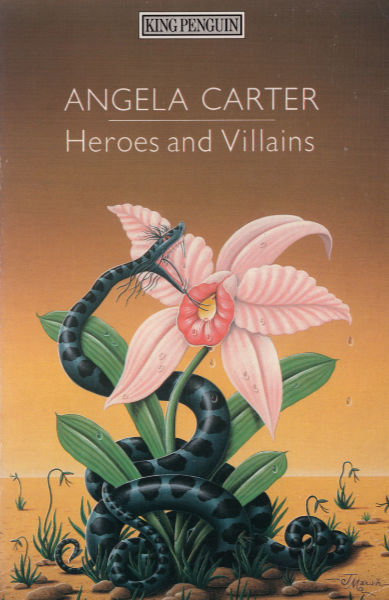
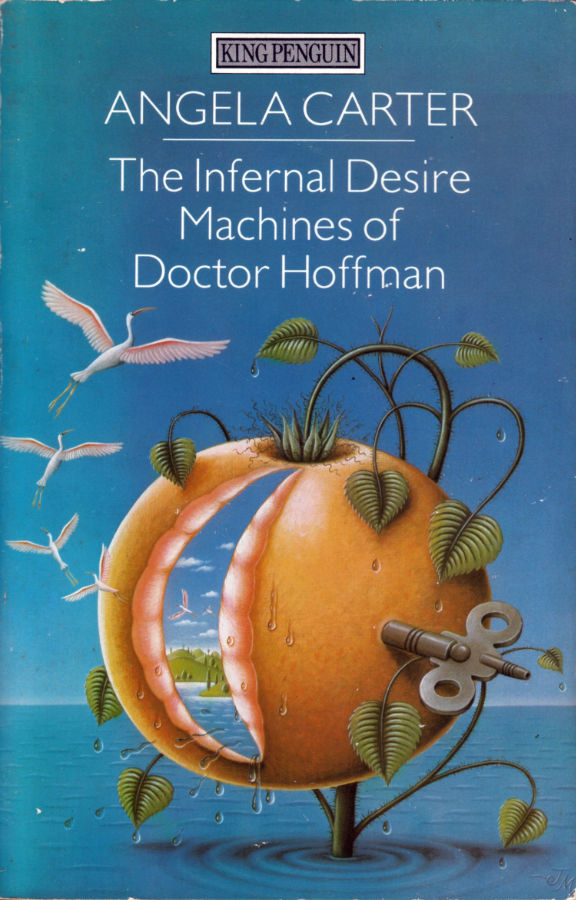
1987 PB art by James Marsh

Begun while Carter was still living in Japan, and first published in 1972 (after her return to the UK), The Infernal Desire Machines of Doctor Hoffman is Carter’s most outrightly fantastic novel, and deservedly finds a place in Moorcock & Cawthorn’s Fantasy: The 100 Best Books and David Pringle’s Modern Fantasy: The Hundred Best Novels. (It was retitled The War on Dreams in the US.)

It begins in an unnamed city in an unnamed South American country. The narrator is Desiderio (“the desired one”), writing the memoir of his young life, when he was branded a hero for his role in ending the war that Doctor Hoffman launched upon the people of that unnamed city—and upon reality itself. Hoffman’s assaults warp time, space, and reason, causing people to sprout peacock feathers, warehouses to turn into palaces, and apparitions of the dead to appear. As Desiderio writes: “in the early days of the war, life itself had become nothing but a complex labyrinth and everything that could possibly exist, did so… the city was no longer the conscious production of humanity; it had become the arbitrary realm of dream.”

The Minister for Determination (to whom Desiderio is private secretary), constitutionally resistant to unreality (he’s convinced Hoffman has released a virus “which causes a cancer of the mind, so that the cells of the imagination run wild”) attempts to counter this encroachment of dream with a series of futile measures, from the use of radar to the use of torture as a means of forcing the unreal to differentiate itself from the real. Sensing they’re losing the war, the Minister gives Desiderio a secret mission: to find and assassinate the elusive Doctor Hoffman.
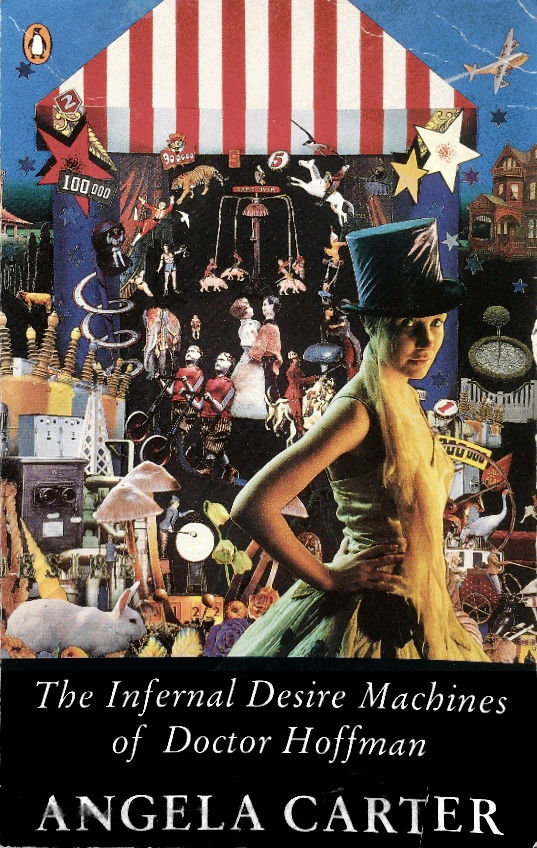
1990 PB, cover art by Andrew Wyatt

Desiderio leaves the city for the town of S, where the proprietor of a travelling peepshow is rumoured to be one of Hoffman’s disciples. Thus begins a series of picaresque adventures that see our young hero living with the native river people (with whom he, having part native parentage, seamlessly blends), working with a circus, travelling with a monstrous libertine known as the Count, stranded with a tribe on the coast of Africa and, finally, dwelling amongst a community of centaurs—before finally arriving at the “Wagnerian castle” of Doctor Hoffman. Throughout, Desiderio is haunted by, and often accompanied by (in a series of disguises he always sees through) Hoffman’s beautiful daughter Albertina, with whom he has, of course, fallen in love.

Just as Heroes and Villains was about the conflict between desire and need, this novel is about the conflict between dream and reason, or desire and reality. At first it seems the Minister (“not a man but a theorem, clear, hard, unified and harmonious”, who “had never in all his life felt the slightest quiver of empirical uncertainty”) represents reality and Doctor Hoffman dream, but when we finally meet Hoffman, he is an equally unimaginative patriarch (“cold, grey, still and fathomless—not a man; the sea”, who “had examined the world by the light of the intellect alone”). Both form a type with other such controlling paternal figures (which includes Doctor Donnelly from Heroes and Villains and Uncle Philip from The Magic Toyshop—what Lorna Sage, in her Writers and their Work volume on Carter, calls “Carter’s puppet-masters”). Contemplating Hoffman, this supposed unleasher of dreams, in all his disappointing rationality, Desiderio writes: “I did not think he knew what desire was.” (And, he muses, perhaps of Carter’s work as a whole: “Were all the potential masters the world held for me to be revealed as nothing but monsters or charlatans or wraiths?”)
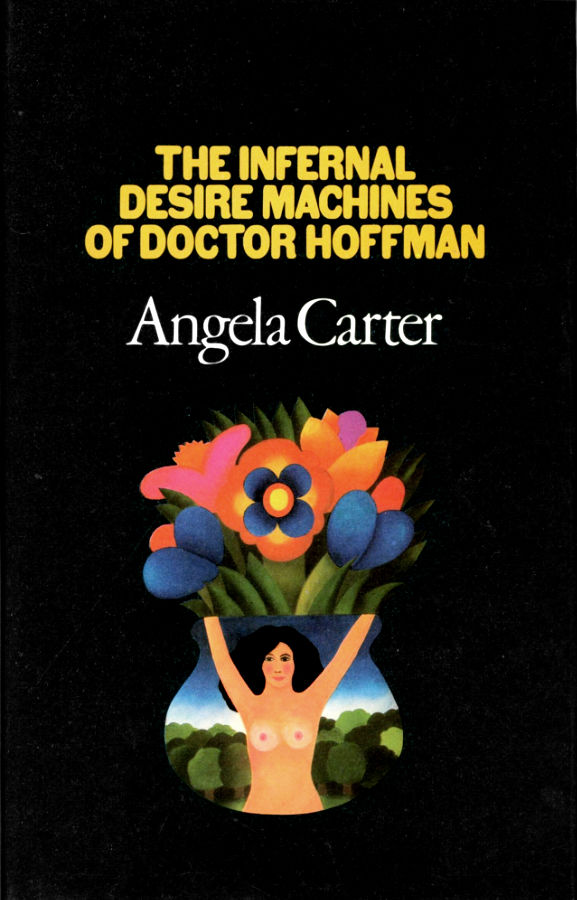
1972 HB, art by Martin Leman

If these are the dark fathers, balancing maternal figures seem absent—Desiderio’s mother was a prostitute who left him to be raised by nuns, Albertina’s mother (Hoffman’s wife) is dead (though she was, at least, a poet). Rather, the presiding maternal force is even more implacable and desire-less than those two male figures: mother nature, at her most arbitrary and indifferent. When the entire circus with which Desiderio has been travelling is killed in a freak natural event, he notes that “the landslide could only be a simple assertion of the dominance of nature herself”. On the coast of Africa (later revealed to be a fantastic coast, and an emanation of the monstrous Count’s desire for self-destruction), Desiderio meets a people who represent “Man in his constitutionally vicious, instinctively evil and studiously ferocious form—in a word, in the closest possible harmony with the natural world”. Mother nature, then, is no refuge from dark puppet-master fathers.

Desire and dream come across as perhaps the only humanising elements in a world otherwise caught between the polarities of cold intellect and a starkly uncaring nature. But even then, desire in The Infernal Desire Machines of Doctor Hoffman is no romantic fantasy. In Carter’s hands, it’s full of casual brutality, tragedy and the darker extremes of perversity. Desiderio’s story takes him through a series of episodes, in each of which he enters a period of narrative stasis, where he lingers among a group of people and experiences their way of life. When he’s with the river-people, we get a disquisition on their beliefs and customs (outwardly placid, they prove to include cannibalism and paedophilia); we learn the histories and nature of the various people who make up the circus, some poignant (as with Madame la Barbe, whose beardedness raised her from being an ordinary girl to being “immensely handsome, widely travelled”, but, nevertheless, “the loneliest woman in the world”) others grotesque (the all-male troupe known as the Acrobats of Desire, who are capable of exchanging body parts with one another, and who gang-rape Desiderio). As far as trigger warnings go, this novel should come with a submachine gun logo on the cover.
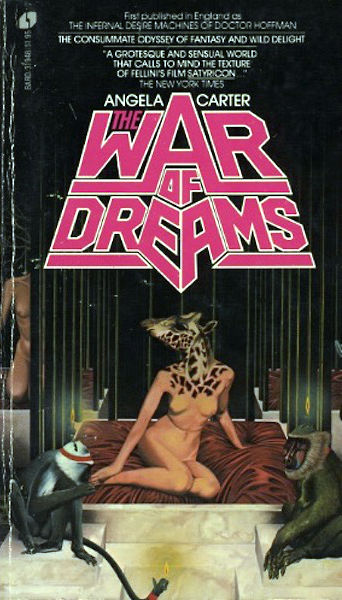
1977 US PB, art by Peter Goodfellow

Perhaps the most notable episode is that of the Count, a figure I can’t help feeling is based on de Sade (and Carter would go on to write a study of de Sade a few years after The Infernal Desire Machines). So incredibly self-centred he never seems to speak to anyone but himself, the Count is “a connoisseur of catastrophe”, “a blasphemous libertine, a blood-thirsty debauchee”, who claims to have “devoted my life to the humiliation and exaltation of the flesh”. Perhaps it’s characteristic of all the male “father” figures in the novel that Desiderio at one point thinks the Count might be the Minister, then later that he might be Doctor Hoffman…

The Infernal Desire Machines has been called a Surrealist novel, but I think that though Hoffman’s efforts are creating a surrealist reality, the novel doesn’t have Surrealist fiction’s lack of narrative coherence. Carter isn’t just letting “psychic automatism” (as the Surrealists have it) take over; rather, her narrative is a balance between the strange images of Surrealism and a conscious engagement with the more nebulous forces of the human condition: desire, dream, imagination, cold reason. Unlike pure Surrealism, it comes with thought applied.

Set as it is in South America, it naturally feels as though it might be called Magical Realism, but I think it’s one of those novels that absorbs so many genre labels—Gothic, Fantastica, Picaresque—without entirely belonging to any of them. (It’s tempting to read the “War on Reason” as sourced in the same media-frenzied, accelerated 1960s as Ballard addressed in The Atrocity Exhibition. But Carter isn’t presenting a dystopia, here. Hers is a world in constant conflict, though the feeling is not of warning about how things might become, it’s about how, for her, the world simply is.)

Carter is generous with her references, and has obviously absorbed a lot of imaginative literature and cinema—far more than would have been admitted in your standard English literary novel of the day: The Cabinet of Dr Caligari and Rotwang’s laboratory in Metropolis get a mention, as does Gulliver’s Travels and Freud. And there’s a distinct air of Kafka, de Sade, ETA Hoffmann and Borges too. There’s a certain Moorcock-ishness to the Law-versus-Chaos conflict between Reason and Dream/Desire, though it’s probably not down to influence. To my surprise, Lovecraft gets a direct quote (“the oldest and strongest emotion of mankind is fear”). And I’d even throw in the 007 films, as Hoffman’s castle, with its high-tech inner chambers, represents nothing so much as a Bond villain’s lair.
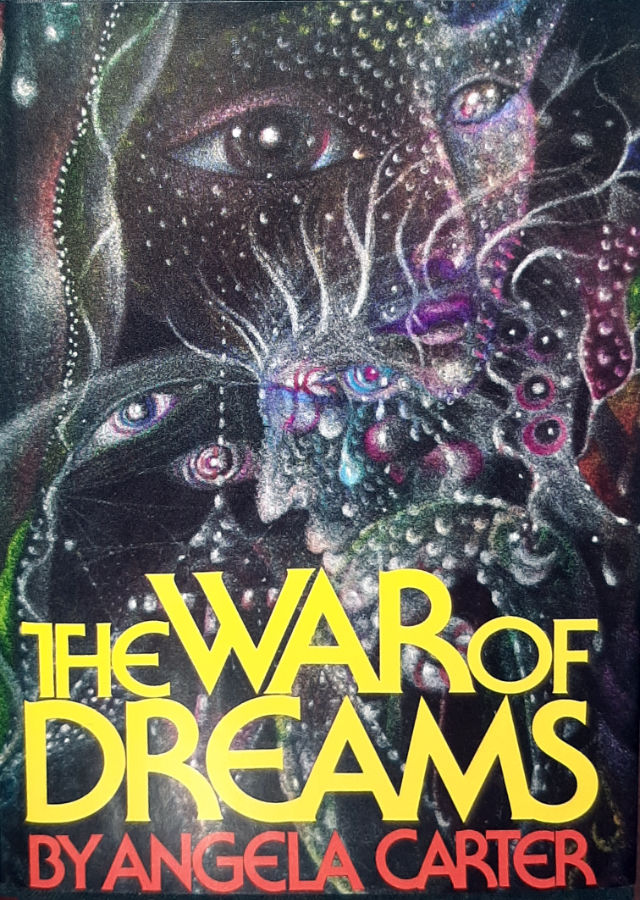
US HB, art by Linda Gardener

Me being me, I even suspected David Lindsay’s A Voyage to Arcturus might have been part of the mince fed into this particular sausage-machine, not just for their shared picaresque form which leads to a disillusioning/mind-opening revelation (which goes back at least to Apuleius’ The Golden Ass), but some specific details. For instance, shortly after meeting the monstrous Count, Desiderio says “His quality of being was more dense than that of any man I have ever met”, which instantly reminded me of Lindsay’s Spadevil, another larger-than-life figure met on the road whom the protagonist takes up with, and whose “body seemed to be composed of some substance heavier and denser than solid matter”. Later, Carter gives us a vision of nature at its most chaotically creative, mixing animal and plant forms: “nature had absolved her creations from an adherence to the formal divisions so biology and botany were quite overthrown and the only animals we saw… seemed more an ambulant vegetable than anything else.” Lindsay’s Matterplay (coming at a similar point in his novel) has a walking tree spontaneously forming from mid-air, before noting “Pure plants and pure animals by degrees disappeared, and their place was filled by singular creatures which seemed to partake of both characters.” Later still, Desiderio meets a hermaphrodite in Hoffman’s castle, with “a voice like a sexual ’cello”; Lindsay’s third-sex Leehallfae has an equally musical voice, “oddly suggestive of a mystical forest-horn, heard from a great distance.”

Throughout, Desiderio is led on by Hoffman’s Fah Lo Suee-like daughter—but is she like Muspel fire drawing Maskull on, or like Crystalman in one of his many deceptive forms? Their relationship is less fraught than that of Marianne and Jewel in Heroes and Villains—unless you read the messiness of that pairing as being externalised in all the horrors and brutality that surround them on their journey—but ultimately it ends as all such highly-strung desire must end: Desiderio tells us early on that Albertina is dead, and that he killed her, even as he loved her.

There is so much going on in The Infernal Desire Machines, it would be impossible to say it was trying to say one thing. It’s not saying desire is good or bad, or that reason is good or bad, rather it’s exaggerating both, and the conflict between them, and laying them out in all their messy, tangled complexity, with lashings of casual brutality, surreal imagery, and a lot of good writing. (My favourite line in the book is early on in the dream-beleaguered city, where Desiderio falls into “a sleep which had now become as aesthetically exhausting as Wagner”.)
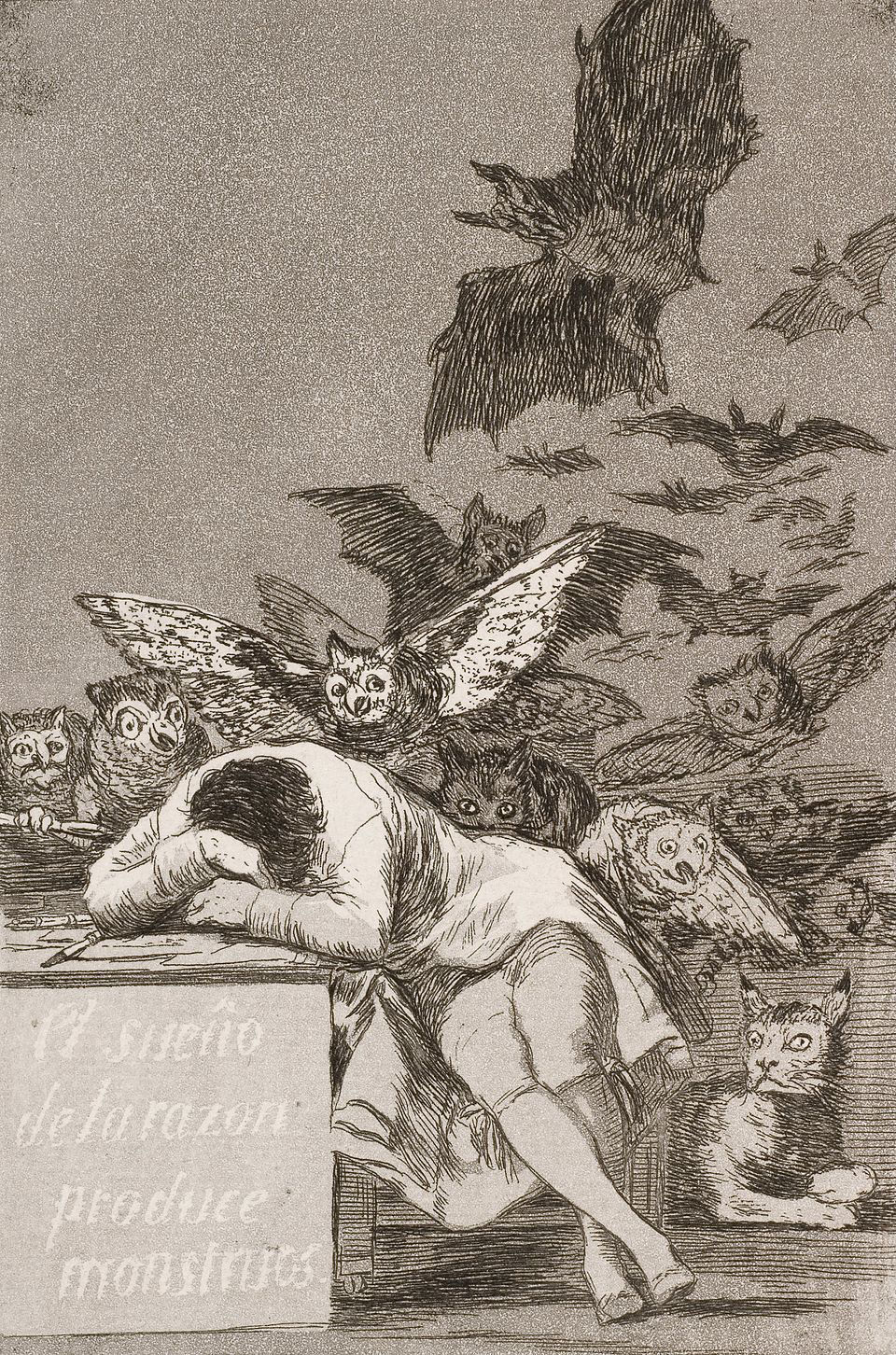
Goya, “The sleep of reason breeds monsters.”

From what I’ve read, there’s a lot more going on in The Infernal Desire Machines than I would be aware of: references to continental philosophy (are the principles of Hoffman’s philosophy to be taken as philosophy, or a satire upon such attempts to intellectualise the unintellectualisable?). At one point Albertina says: “the most monstrous aberrations are bound to flourish in soil once it has been disinfected of the imagination”, which seems the complimentary opposite of Goya’s “The sleep of reason breeds monsters.” Which is true? If both are, and the ideal is balance, then The Infernal Desire Machines of Doctor Hoffman is not a book about finding a balance. Although, as Albertina says, “Love is the synthesis of dream and actuality”, The Infernal Desire Machines itself pursues both to the point of breakage, leaving poor Desiderio old and alone, living with the memories of the desires of the past, plus a hot drink at bedtime. Perhaps “the time of actualised desire”, as he calls the invasion of the real by dream, was simply his youth.

Lorna Sage notes that The Infernal Desire Machines of Doctor Hoffman was “ignored, or treated with incomprehension and contempt, by most mainstream critics”, perhaps because the taint of the fantastic—particularly in a novel that so evidently takes a glee in its own imaginative fecundity—wasn’t generally considered acceptable at the time by the British literary establishment.
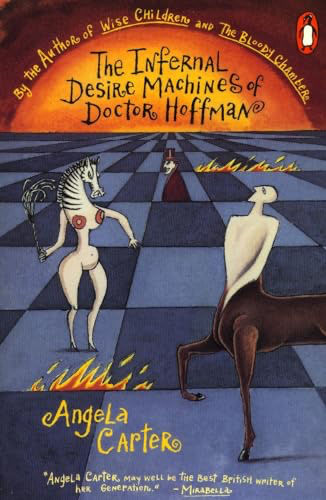
cover art by Roxanna Bikadoroff

Although I am ultimately impressed, I wasn’t always engaged by the book. When the narrative slowed to examine, at length, the lives of the river-people or the brutal centaurs, I was puzzled as to what it was doing. Maybe another read might make it fit together, but for now I have to think of such moments as sparks of imagination given free reign, jewels thrown into this bag of strange riches. It’s part of this novel’s character that it contains such a cornucopia of ideas, scenes, characters, and even longueurs.

(And the jewel image reminds me of Fritz Leiber on Clark Ashton Smith, who said Smith’s tales were “Innsmouth Jewellery; like strange ornaments, the metal elaborately inlaid and fired, studded with unknown semi-precious stones, from an unknown and timeless culture.” And Leiber, oddly, is another fantasist I found contained in Carter’s capacious novel, in the image of a night-time visitor to Desiderio’s rooms—Albertina, again, in yet another guise—a being with transparent flesh, so she appears as a “miraculous bouquet of bones”. Like the ghouls of Leiber’s Llankhmar. Had Carter read Leiber, too? Or was it just that her imagination was so wild, in this novel, it lapped on all these far shores of the fantastic?)

^TOP

Terminal Boredom by Izumi Suzuki

Cover by Araki

Izumi Suzuki was part of what sounds like Japan’s post-60s New Wave of Science Fiction, in which (as in the UK at the same time) the country’s authors made a conscious attempt to move away from the commercial American style. Hers in particular became known as the “SF of manners”, though I’ve a feeling that phrase loses a lot through translation.

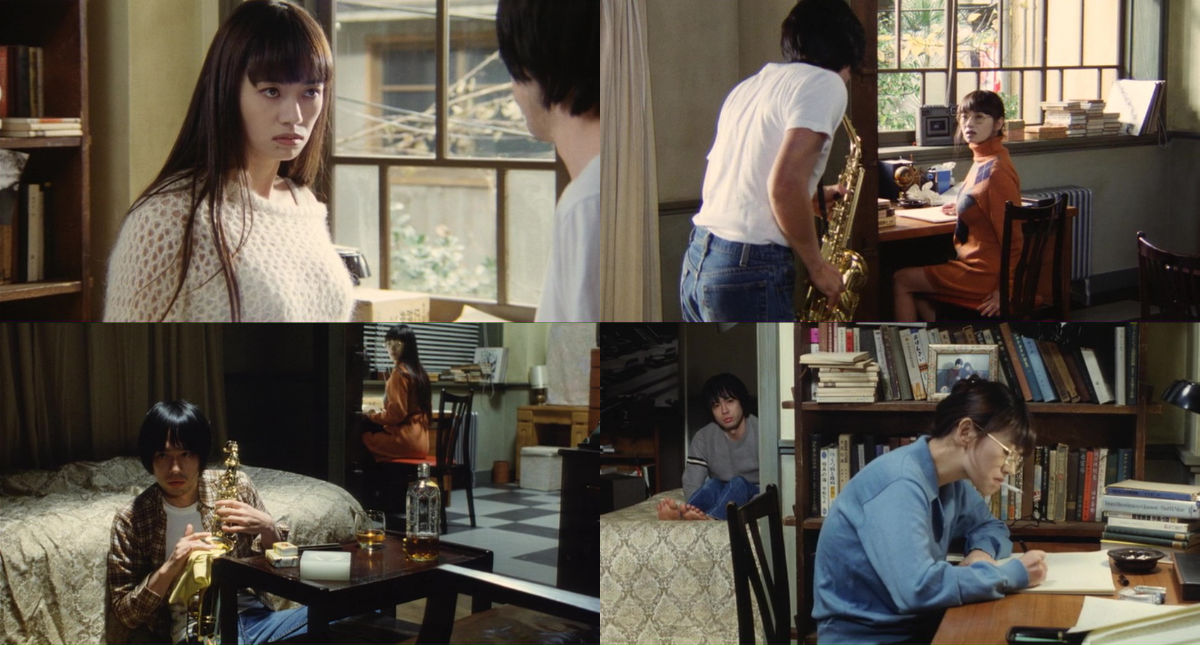
Born in 1949 (making her a contemporary of Haruki Murakami, whose world of jazz cafés and disaffected twenty-somethings she shares), she moved to Tokyo after winning recognition for some of her early writing, and there became a stage and film actor, as well as posing for the art-and-bondage photographer Araki. (That’s her, by him, on the cover of Terminal Boredom.) She was apparently introduced to SF in 1970, and began publishing it starting with “Trial Witch” in S-F Magazine in 1975. Her writing career seems to have gone into overdrive after the death of her ex-husband, the experimental jazz saxophonist Kaoru Abe, with whom she had a daughter. (A 1992 novel and 1995 film, Endless Waltz, depicted a fictionalised version of the couple’s stormy relationship.) Her health declined, though, and she eventually took her own life in 1986.

Scenes from Endless Waltz (1995) – much honking of free jazz, but little about Suzuki’s writing

Terminal Boredom, published this year by Verso Books, is her first English-language collection, with seven stories by almost as many translators (Daniel Joseph, David Boyd, Sam Bett, Helen O’Horan, Aiko Masubuchi, and Polly Barton). There’s no indication of when the Japanese originals first appeared, which is a pity, as I like to at least guess at a writer’s development from knowing which are the earlier stories, but perhaps seven stories is too small a selection for that, anyway.

The opening story, “Women and Women”, is set in a future where “Women have been left carefully husbanding the scant resources of a planet stripped bare by men.” The few remaining males — essential for purposes of reproduction — are housed in an area known as the GETO, the Gender Exclusion Terminal Occupancy Zone. Suzuki gets round the traditional SF exposition problem by having her narrator, a teenager in this mostly-manless world, share the sort of wildly speculative myths about adulthood teenagers in any age do. To her, “Men are an offshoot of humanity… but they’re a deviant strain. They’re freaks…”

“Which is exactly why the males have to be kept in the GETO. If they were allowed to roam free, the radiation or whatever it is they emit would make all the women around them pregnant.”

But when she sees what she just knows to be an actual boy, of her own age, passing her home one night, she’s fascinated, and starts leaving messages for him to find.

Suzuki, from the cover of a Japanese collection

Male-female relations — always of a distinctly ambivalent kind, making me think of a less intense version of that from Angela Carter’s Heroes and Villains — form the core of the book’s preoccupations, but it soon becomes clear the emotional disconnection that characterises these relationships extends to those between women, too. For instance, in “You May Dream”, the narrator too-casually agrees to the request of a friend, whom she spends most of the time feeling vaguely irritated by, to enter her dreams. This is a future where over-population has resulted in lottery-chosen people being suspended in cryosleep until enough spaceships can be built to take them off-world. Sleepers can bond with one chosen person and take up residence in their dreams. The narrator thinks of her friend as her opposite, even her Jungian shadow, which might make her sound like ideal dream material, but it turns out they’re totally incompatible: “She infused a syrupy wetness into my world.” The narrator soon finds herself reluctant to sleep, because of the burden of her friend’s too-different personality.

Perhaps the best story for capturing Suzuki’s tone is the last one, “Terminal Boredom”, set in a future where mass unemployment has resulted in a habitually bored young populace too unmotivated to remember to even feed themselves regularly. “Everyone,” the narrator says, “lives in a happy-go-lucky depression”, more (but only slightly more) engaged in what they see on TV than in reality:

“Ever since I’ve been old enough to really understand the world (these past two years or so), I’ve never once cried at a scene in real life. Whenever something serious happens, I just convince myself it’s no big deal… I’ve been fooling myself this way for long enough that it’s become a habit, and now nothing affects me.”

When a woman is murdered right next to her and the boyfriend she mostly can’t be bothered to meet, they can’t quite grasp what has happened, until they see it again, on camera. It starts to feel like the sort of world J G Ballard was always predicting — a future of boredom through enforced leisure relieved by explosions of violence — only, it doesn’t have the levels of wealth he assumed would go with it.

Suzuki’s is a world that seems particularly post-counter-cultural. The book flap describes her stories as “punky and pitch-black”, but the punkiness is most definitely of the “pretty vacant” rather than pogo-dancing variety. Characters don’t have friends so much as people they habitually hang out with, and get vaguely irritated by, though not enough to make them seek out other people:

“What are your relationships usually like?”
“Totally throwaway. I anticipate the break-up and hint towards it to prepare for a smooth exit.”

Japanese cover to her 1978 collection, Women and Women

Some of Suzuki’s characters (if not all of them, at some level) are just as dissociated from themselves. In “Smoke Gets In Your Eyes”, one of the narrators is a woman prematurely aged by a drug she overused, who approaches the still-young man she once had a relationship with, only to find he doesn’t recognise her, or at most thinks she might be his ex-girlfriend’s mother. In “That Old Seaside Club”, the narrator says she’s 19, but is haunted by a failed adult life she surely has not yet lived. “Night Picnic” is about a family who think of themselves as the last surviving human beings on a distant, non-Earth planet, desperately trying to cling to supposedly authentic human ways my mimicking what they see in old movies and read in old books. (As all the cultural references in this story were American, I wondered if this might have been a satire on US culture taking over Japan’s.) In “Forgotten”, the key difference the narrator’s alien boyfriend notes between humans and his own kind is that humans forget while Meelians don’t, which is why “we haven’t had a war on my planet for two millennia”. “Whose life is this? It’s completely empty,” says one narrator, of her own life, and it’s a quote that could fit any of her stories.

I’d like to read some more stories by Suzuki, though perhaps I wouldn’t read them back-to-back, as that malaise of disaffection can be hard to read too much of. A biographical introduction would be nice, too.

(Another story, “The Walker”, translated by Daniel Joseph, is available at Granta, though it’s quite different in feel from all the stories in Terminal Boredom.)

Suzuki’s 1978 collection, Teatime Anytime, in the only scene from Endless Waltz that shows her books

^TOP

Heroes and Villains by Angela Carter

Penguin 1988 cover by James Marsh

A few Mewsings ago, I reviewed H M Hoover’s Morrow books, in the first of which a pair of children living in a semi-barbarous, post-apocalyptic society escape to the more technologically advanced society of Morrow. In Angela Carter’s (not YA) Heroes and Villains (1969), the opposite happens. Carter’s heroine Marianne (a young woman rather than a child) leaves her home community, a fenced-in remnant of the pre-“blast” civilisation dwelling in the buildings that survived this particular future’s apocalypse — mostly farmers and soldiers with the added “intellectual luxury of a few Professors who corresponded by the trading convoys” — for the wastelands, in the company of a barbarian man, Jewel. Whereas Hoover’s Tia and Rabbit leave because of their telepathic abilities and outsider status, Marianne goes because she’s bored with the possibilities offered to her by her society. She’s always been drawn to the barbarians — by their freedom, their vivacity, their bright colours. In Carter’s post-apocalyptic future, it’s the technological society that’s the most repressive (the soldiers are “developing an autonomous power of their own”, and look set to take over once the last few Professors die out). The barbarians can afford to be more free — in part because they live by raiding the farmers every so often — but are nevertheless beset by disease, physical ailments, and, crucially for Marianne, superstition. Hoover’s Tia left “the Base” because they thought she was a witch; arriving at Jewel’s people’s latest home, Marianne finds herself believed to be a witch, too, and doesn’t even have Tia’s witchy telepathic abilities to make up for it.

Carter, though, is less interested in the differences between the two types of communities, as to the dichotomy Marianne is caught by throughout the book, two poles she can’t escape because she carries them within herself, and often finds difficult to tell apart: desire and need.

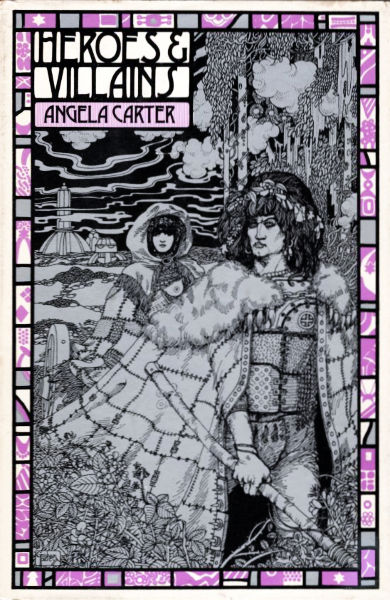
Beardsleyesque Graham Percy cover

Jewel takes Marianne to his people, currently living in a large, semi-ruined house beyond the swamps and forests that surround her former home. There, she meets Mrs Green, the tribe’s matriarch, herself an escapee from the world of the Professors. Mrs Green is motherly, and treats everyone as though they were just big children, which, in a sense, they are. But these barbarians also have a dark father-figure in the shape of Doctor Donnelly, a former Professor who, “bored” and “ambitious”, went out into the world and, Kurtz-like, turned himself into a shaman and holy man for this tribe, frightening, guiding, and controlling them with his fits, his visions, and his stuffed snake. He feels like a character that’s appeared in the other Carter novels I’ve read (though quite some time ago), the puppeteer/shop-owner of The Magic Toyshop and the titular doctor from The Infernal Desire Machines of Doctor Hoffmann. Unpredictable, entirely self-serving, helping Marianne one moment, plotting to poison her the next, Donnelly is undoubtedly the book’s liveliest character, also its most dangerous. He instructs and warns Marianne through a series of slogans daubed above his door, most of which are nonsense, but one of which is:

“OUR NEEDS BEAR NO RELATION TO OUR DESIRES”

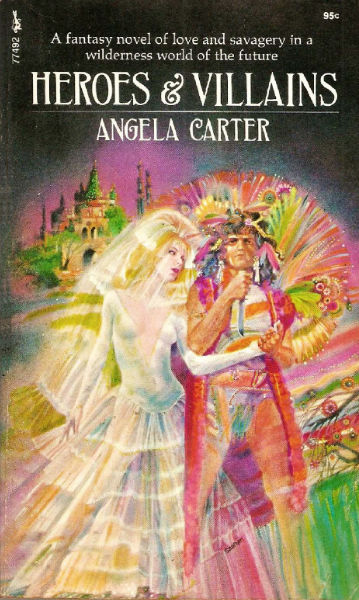
Pocket Books PB, cover by Gene Szafran

Marianne is obviously drawn to Jewel, but not quite enough to want to stay with him. When she attempts to escape (after Jewel’s brothers threaten to rape her) Jewel tracks her down and rapes her himself. She’s then brought back to the house and told she’s going to marry Jewel, even though his people are all convinced Marianne is a witch and ought to be burned. (Motherly Mrs Green’s sympathies are all with her boy, Jewel, who she felt had no choice but to do what he did.) Marianne and Jewel spend the rest of the novel alternately hating and needing one another, hurting and healing one another, breaking up and coming together, giving in to each other one moment, struggling and fighting the next. For most of its second half, Heroes and Villains is like being forced to witness the often verging-on-violence tussles of a quarrelsome couple who can’t live together but can’t live apart either. Morrowian telepathy might help, but I can’t help feeling, in Carter’s world, it would only make things worse, as the real battle is within each character, with their own human nature. Carter’s post-blast future is not, like The Death of Grass or Day of the Triffids, an exploration of how easily civilisation might give way to barbarism; it’s more about how the world changes when you grow up and leave the (here) boring world of childhood for the dangerous and never-satisfying world of adulthood, and meet with only frustration, pain, and more boredom:

“Boredom and exhaustion conspired to erode her formerly complacent idea of herself. She could find no logic to account for her presence nor for that of the people around her nor any familiar, sequential logic at all in this shifting world; for that consciousness of reason in which her own had ripened was now withering away and she might soon be prepared to accept, since it was coherent, whatever malign structure of the world with which the shaman who rode the donkey should one day choose to present her.”

And at the heart of it, that constant inner struggle between desire and need:

“Night came; that confusion between need and desire against which she had been warned consumed her. If it was only that she desired him, then it became a simple situation which she could perfectly resolve while continuing to despise him. But if he was necessary to her, that constituted a wholly other situation which raised a constellation of miserable possibilities each one indicating that, willy nilly, she would be changed.”

It’s evident Marianne will never decide one way or the other. She and Jewel sometimes fit each other’s desires, sometimes fit each other’s needs, but rarely for long or at the same time. It’s all rather despairing (“There’s nowhere to go, dear,” said the Doctor. “If there was, I would have found it.”) — and not because this is a post-apocalyptic, ruined version of our world, but because it’s an emotional picture of the world as it can be now, if you’re caught between incompatible desires and needs, and perhaps trapped in a marriage you sometimes want and sometimes hate. The post-apocalyptic wasteland just exists to add that note of hardly-necessary hopelessness to an already hopeless domestic situation. As Mrs Green says:

“It’d be hell with your Dr Donnelly running everything, real hell, no respect for the old or nothing. Only tortures, mutilations and displays of magic.”

I can’t help feeling, though, that Dr Donnelly is running the world in Heroes and Villains, or at least his approach is the only one that works. He’s given up all attempt at being rational and consistent, and has embraced a sort of wilful madness. As a child, Marianne lived in a world of carefully-protected reason; bored with that (and after the death of her father) she left it, to find that nothing would ever be the same again:

“When I was a little girl, we played at heroes and villains but now I don’t know which is which any more… Because nobody can teach me which is which or who is who because my father is dead.”

So, the comparison with H M Hoover’s Children of Morrow is less about the two authors’ ideas on technological as opposed to barbaric societies, and more about differing complexities in their characters’ inner worlds, the simplicity (or not) of their needs and desires, the difference, perhaps, between childhood’s easy answers and adulthood’s impossible questions.

^TOP