
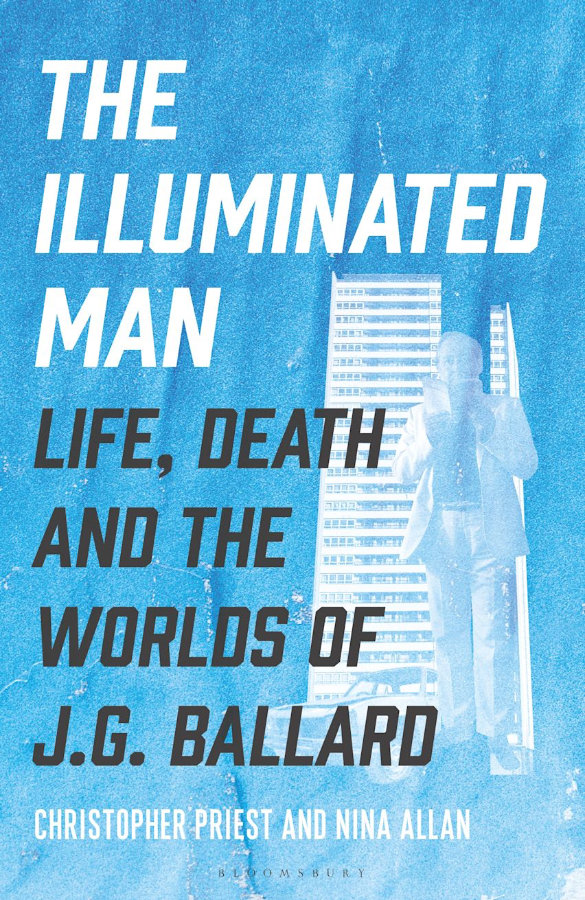
 If you want to learn about the life of JG Ballard, there are plenty of sources. There’s Ballard’s own writings on the subject, which includes both memoir (Miracles of Life) and fiction (Empire of the Sun and The Kindness of Women), which might be grouped together as self-mythologising (which I don’t intend as a negative term). Then there’s David Pringle’s detailed chronology (currently spread across ten or so volumes of the Deep Ends anthology, and really in need of standalone publication), the John Baxter biography The Inner Man from 2021, and now The Illuminated Man: Life, Death and the Worlds of J G Ballard by Christopher Priest and Nina Allan.
When The Illuminated Man was first announced (at that point, it was only to be by Priest), I felt there was a certain amount of relief that Ballard would be getting a respectable biography, as Baxter’s book had attracted a certain amount of criticism (not least from Ballard’s daughters) for factual inaccuracies and a general misrepresentation of Ballard’s character (as, Edmund Gordon writes in a review of The Illuminated Man in The New Statesman, “a racist, sexist, mendacious creep, beset by alcohol problems and ‘psychotic tendencies’”—though that wasn’t the impression I came away from it with). This, then, was to be a more acceptable, hopefully more scholarly—if less gossipy (though it’s good to have both)—biography, presumably to be written with the collusion of Ballard’s estate (and, crucially, his daughters).
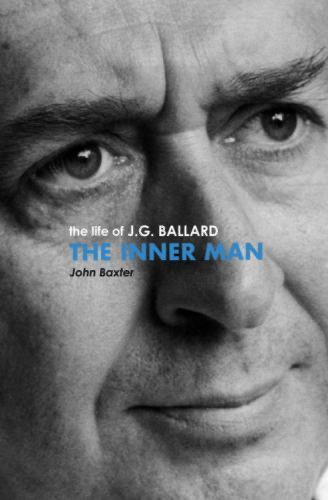 (I have to say that, at the time, I was quite grateful to read The Inner Man—always taking its speculations about Ballard’s psychology with the same grain of salt I’d bring to any biography. It was, for me, the first take on Ballard’s life I’d read that wasn’t by Ballard himself, and so was a welcome second perspective. Baxter had, for instance, clearly spoken to many of the other people involved, so that second perspective wasn’t only his own. And I couldn’t help feeling its dips into gossip and anecdote were a welcome contrast, a circus tent set up outside the crystalline pagoda of Ballard’s own powerful self-mythologising. Where else would I have got to read the story of Ballard buying The Who’s “Anyway, Anyhow, Anywhere” and saying he preferred it played at 33rpm (as opposed to the faster 45rpm, presumably)? I even think Baxter’s might have been a biography Ballard would have enjoyed—had it, that is, been written about anyone but himself! After all, Ballard had good things to say about Baxter’s biographies of Steven Spielberg—“Baxter is a shrewd, witty and very readable writer”—and Woody Allen—“astute and entertaining”.)
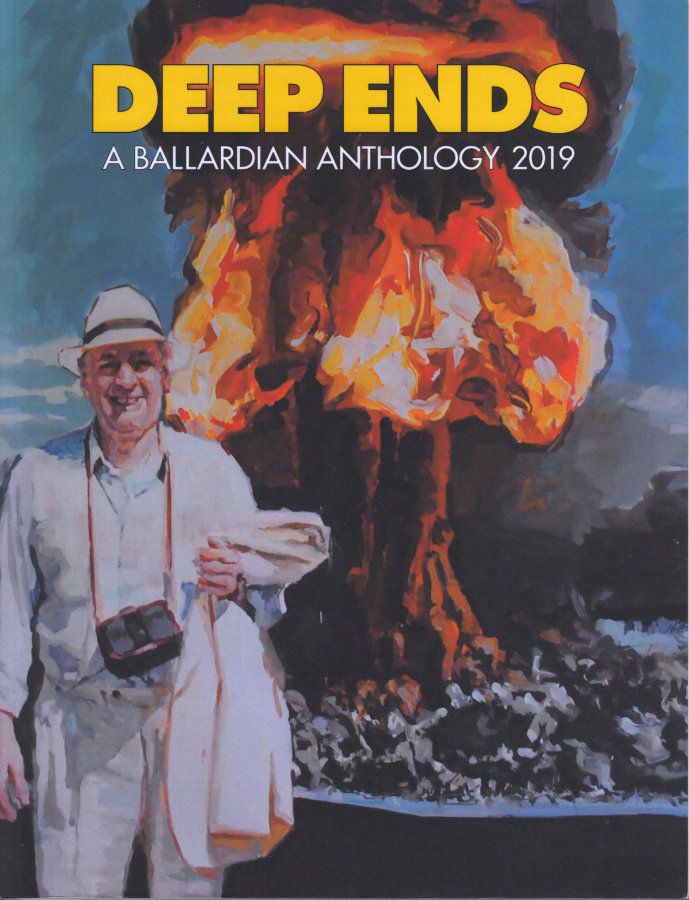
Cover art by Luca Del Baldo
Sadly, though, that idea of The Illuminated Man wasn’t to be. Priest fell ill and died before the book was finished. His partner (and, later, wife) Nina Allan has finished it but made two crucial decisions that fundamentally affected its character. First, Priest’s version of the book has been left unedited, even when some chapters clearly feel like they were written by a man of flagging energies. Second, Allan has taken this opportunity to write about Priest’s final illness and death in some detail. Which is understandable, considering what she and he must have been through, but I have to confess I skipped those chapters. The result is an unblended mix of straightforward biography and memoir about two different people. (In fact, the book makes most sense regarding the biographical chapters about Ballard as materials offered to support the memoir covering Priest’s illness and death.)
Christopher Priest’s portions of The Illuminated Man seem strongest, to me, in their critical comments on Ballard’s fiction. For instance, this:
“‘The Voices of Time’, we soon discover, is a story that does not give up its secrets. If there is a plot, an underlying purpose, it constantly evades the reader. Instead, every page, every paragraph, seems charged with meaning, never clarified, never given the benefit of cause and effect. The reader is cast alone. If obscurity is art, here we find it—but ‘The Voices of Time’ is not obscure.”
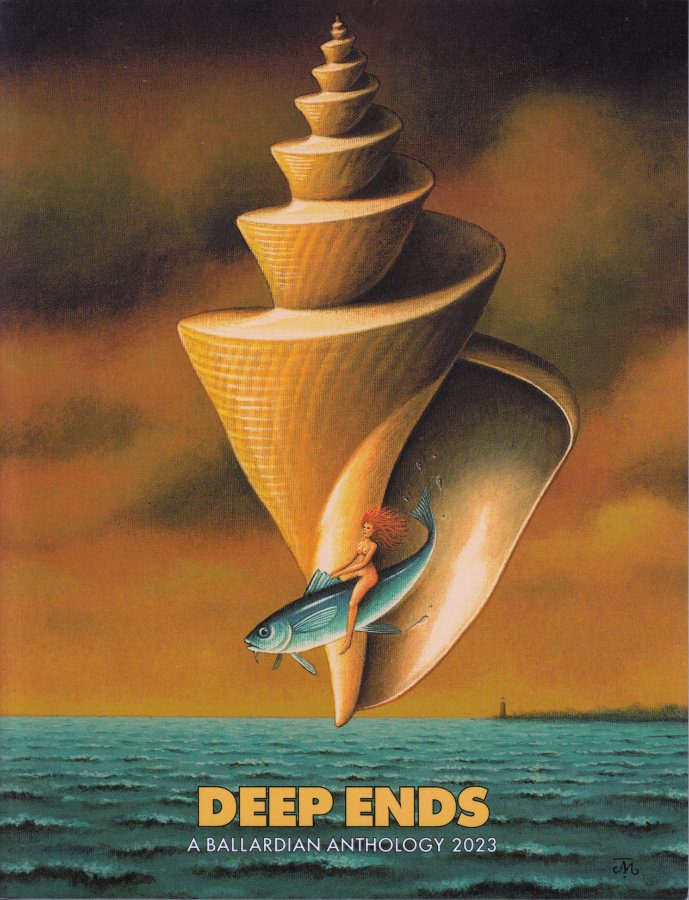
Cover art by James Marsh
That’s the sort of thing I want from critical writing: it makes me want to return to the story, and gives me permission to feel confused as to what it’s presenting. Accept the confusion and bathe in the meaning, Priest is saying. Good advice.
Allan’s are (necessarily) the more complete sections, whether biographical (thanks to her interviewing the people involved where possible) or critical (her comments on Ballard’s final novels, for instance, make me want to give them another—or in some cases a first—go).
Towards the end of the book, Allan asks, of biographies: “Are we reading to confirm that our hero really was a hero, or to discover that they were secretly a monster?” For me, it’s neither. I never look for writers I admire to be heroes—certainly not saints—because that’s plainly only going to end in disappointment. What I want is to get a glimpse of the human being behind it all. Ballard was, both in interviews and on the page, an impressive man, but not the sort to ever admit to, say, playing The Who at the wrong rpm, which is, frankly, the sort of thing I want to read! The Illuminated Man provided a better example though, when Allan looks at a rare Ballard notebook for a novel he never completed (he destroyed all such preparatory materials once a book was finished). Seeing him, in his notes, trying out ideas and asking himself questions, feels like a wonderfully humanising moment, a side of him that never comes through in his interviews and writing.
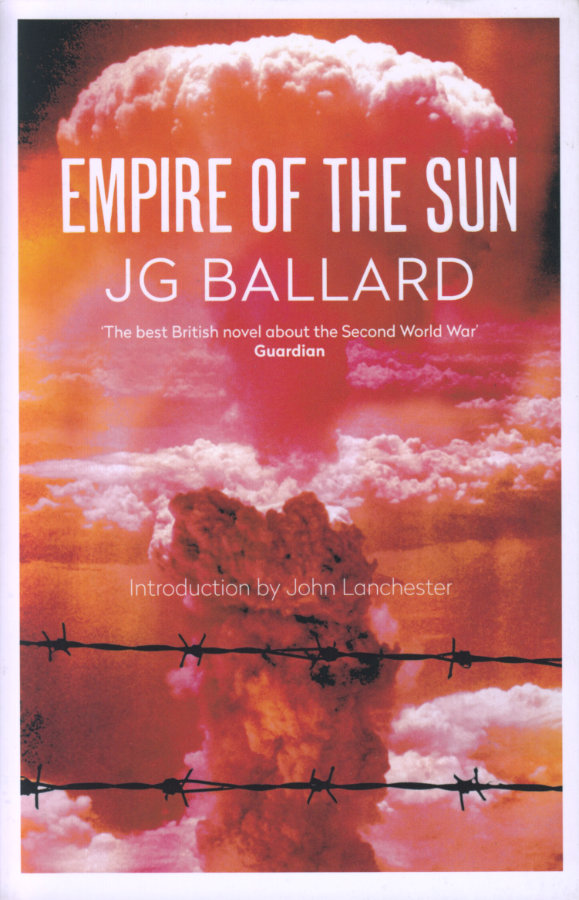 As I say, I think of Ballard’s own writing on his life as self-mythologising, but I don’t mean to imply he’s covering up the truth; rather, he’s coming up with the version of events that best expresses how those events felt to him—how he experienced them, what they meant to him—which is a crucial difference (especially when those events are so intimately entangled with his fiction). We all alter the facts of our lives to fit an evolving inner story—unconsciously streamlining them to bring out the meaning they have for us. It’s only when it’s someone gets a proper biography written about them that this really comes to the fore. In a sense, Ballard’s version of his own life, as presented in both the novels and the memoir is the core of his whole body of fiction, which might all be understood as a complex response to traumatic events and times, an attempt to make meaning out of often disparate events, ideas, experiences. Having this myth brought up against the facts does not invalidate the myth, but emphasises its artistry.
Ballard himself provides an example. In Empire of the Sun, young Jim is separated from his parents for the duration of his internment by the Japanese; in reality, as Ballard admitted, he was with his parents the whole time. But, he said, he made the change because when he was in the camp, his parents were no longer the ones who had control over his life—they couldn’t punish or reward, and were busy being revealed as all-too-human beings, in a sudden change from their former lofty distance. They were, in a sense, no longer parents (just as Ballard was abruptly shunted into no longer being a child). Jim’s being separated from his parents in Empire, Ballard said, was how it felt, hence the myth, the fiction. (Thus also fitting it into the standard fairy tale trope of children thrown out into the wild alone.)
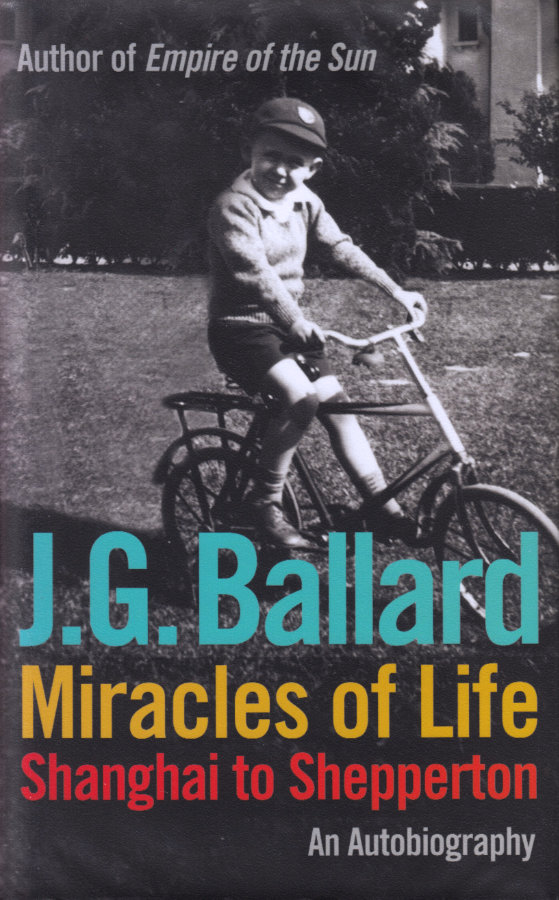 I don’t know if The Illuminated Man can really be a replacement for Baxter’s The Inner Man. At one point Allan castigates Baxter for presenting unattributed information, but on the same page (p. 199) she has a block quote that is itself unattributed. (Maybe that was a publisher’s error.) She mentions Ballard’s family’s unhappiness with Baxter’s book, which was in part due to his sometimes overplayed speculations on Ballard’s psychology, but Allan then goes on to speculate whether Ballard would have remained faithful to his wife, had she survived, which seems, to me, on the same level.
But that’s what biographies do. I only know Ballard through his fiction, interviews, and other writings, and I like to learn about his life as a sort of accompaniment to the writing. I’ll keep The Illuminated Man on my shelves, but it’s probably The Inner Man I’ll refer to first when I need to, if only because it’s in chronological order. (The Illuminated Man, for instance, has a chapter on Ballard’s novel Hello America after the one on The Empire of the Sun, and a chapter on the early Vermillion Sands stories after the chapter on Crash. If nothing else, this leaves out the connecting tissue: what was Ballard doing before and between these books?)
Ballard was evidently a complex man—that sort of fiction wouldn’t come from someone who wasn’t. In a way, his fiction arrived pre-analysed (though in a distinctively Ballardian fashion), and it begs for other takes, going deeper, and seeing things Ballard himself didn’t highlight. It’s an infinitely rich body of work—as, no doubt, was the man himself, and the myth he created.
I’ll end with something from Nina Allan on Ballard the man:
“…listening to him talk—the tone of his voice, the clarity of his thinking, the whole vast hinterland of memory and intellect that lies behind the words he speaks has an immediacy and power that exceeds any number of pages filled with third party speculation and literary analysis.”
But it’s good to have the third party speculation and literary analysis all the same.


