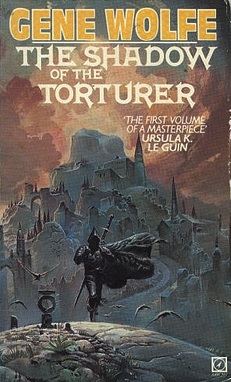
Gene Wolfe has a reputation as being one of those writers whose books & stories you have to read twice. He buries subtle clues in what the Wikipedia article about him calls his “dense, allusive prose”. He uses unreliable narrators. In reviews, people talk about “getting” him, or “not getting” him, making it sound as though there’s a secret to reading Wolfe, a special technique you don’t need for other writers. So, when I came to read him, I found myself asking questions I wouldn’t normally ask. Was I going to have to take notes? Was I going to have to disbelieve everything his narrators said? Was I going to have to buy a new, bigger dictionary? And of course, was it really going to be worth it?
Sometimes a reputation like Wolfe’s can be a writer’s worst enemy, or a reader’s. It overloads your enjoyment of them with expectations no writer can meet — and, when I think about it, I, as a reader, don’t really want. Do I really want to read a writer with a reputation for being “difficult”? Where’s the fun in that? Reading should be fun, after all. But there’s also something so attractive about that sort of reputation — Wolfe seems to be offering something other writers don’t have. Surely he’s worth a try? So I tried. And, at first, I stumbled. But something drew me on. I kept finding myself buying another book by him, giving him another go. Now, two fat novels, two thin novels, and two collections of short stories later, I’m beginning to get a handle on Gene Wolfe. And the first part of that “getting a handle” on him has been learning to forget the reputation. With a writer like Wolfe, it’s all too easy to bamboozle yourself into thinking there’s loads of things you’re missing, all sorts of tricks and literary techniques, levels of significance and meaning, going on that are somehow subtly above your head. But when it comes down to it, Wolfe is just doing what all good writers do — he’s using words to tell a story. If you start with that, things begin to make sense.
 I began, as so many readers of Gene Wolfe do, with The Shadow of the Torturer, the first part of The Book of the New Sun, the fantasy-flavoured SF series that really made his name back in the eighties. I’d actually read this one many years back, but hadn’t followed on with the rest of the series. I loved the beginning, with Severian of the Guild of Torturers learning his gruesome craft at the slightly Gormenghastian Citadel, but after that things went a bit weird, with a trip to a strange botanic garden which seemed to bend space, and perhaps time, too; a puzzling episode with a wandering theatrical troupe; and a seemingly groundless duel fought with blade-sharp plants — interesting idea, but why was it happening? The abrupt shift from a fantasy feel to more explicit SF put me off (being more of a fantasy reader than an SF one — more so, at the time). Or perhaps it was the sudden disjointedness of the storytelling, leaping from one episode to the next without the usual causal flow you get in traditional fantasy. But a couple of years back I bought the series again, in a single shelf-bowing volume, Severian of the Guild, and read the whole thing through. It was enjoyable, certainly — not quite to the mind-blowing level I’d been expecting (or over-expecting, I should say, because it’s always a bad idea to set your expectations so high — another minus point for having an impressive reputation) — but it was certainly different enough to have been worth reading. One reason I wasn’t 100% satisfied may have been that, having heard Severian, the narrator, was unreliable, I’d been expecting a moment of revelation near the end, when all that he’d said would be suddenly put into a different context — a sort of Sixth Sense moment — but that never happened. In fact, looking back on it, I can’t think of any explicit episode where Severian’s narration was blatantly untruthful, which was what I’d been led to expect. (Occasionally evasive, yes, in the sudden leaps in the plot, but no outright lies. None that stick in my memory, anyway.)
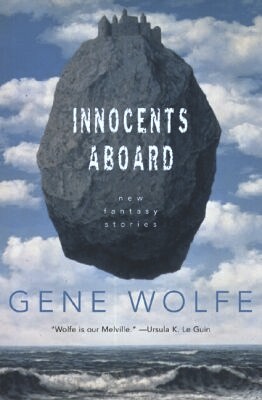
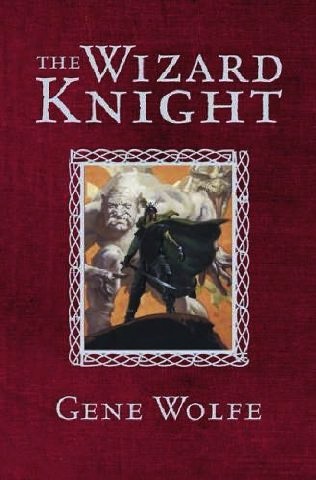
 Severian of the Guild left me unsure about whether I’d “got” Gene Wolfe, though I’d enjoyed it enough to follow it with Innocents Aboard, a collection of fantasy short stories. But that left me even more unconvinced. I still felt I was missing out on something. I was still trying to read the reputation, not the Gene Wolfe that was. Sometime after this, I came across an article by Wolfe about how much he liked The Lord of the Rings (“The Best Introduction to the Mountains“). It’s always gratifying to find an intelligent writer who admits to liking Tolkien — so many of them, even in the fantasy field, are offhand or disparaging, but Wolfe was genuinely enthusiastic. And it turned out he’d written a full-on fantasy himself, The Wizard Knight, which sounded like it would be just my thing. I decided to give him another go.
I read The Wizard Knight a few years back, and even wrote a blog-post about it at the time. It’s no longer there — it got whittled away as part of the process of upgrading to WordPress, when I realised I no longer agreed with it — but it was mostly complaining about authors writing extremely long books which aren’t, when it comes down to it, worth spending that much time reading. Having finished it, I got rid of The Wizard Knight and decided to forget Gene Wolfe. If I wasn’t going to “get” him, then I wasn’t going to spend any more time trying.
But then something odd happened. I found myself thinking back on The Wizard Knight almost fondly. It had seemed, while reading it, such a struggle to get through, but now, the more I thought on it, the more I found myself admiring it. I began thinking of it as one of the best fantasy books I’d ever read. I ended up buying it again, that fat nine-hundred page, wrist-cruncher of a novel, determined to re-read it. (Which I haven’t yet done. It’s sitting on my shelf right now, calling to me, forming its own little gravity well. Some of the slimmer paperbacks have in fact started orbiting it. I’m worried it might form a literary black hole. Perhaps turn into Ulysses.)
 Now, I was determined to crack the Wolfe code once and for all. I bought his most well-known collection of short stories, The Island of Doctor Death and Other Stories and Other Stories (not a typo). If this didn’t give me the answer, I thought, nothing would. I started reading it. And, finally, I began to “get” Wolfe. Particularly in the novella “Tracking Song”, which seems to be a dry-run for Severian of the Guild, I started seeing through the reputation and realising there was an author behind it who was really worth reading. I have to say I still haven’t totally “got” Wolfe — I read An Evil Guest when it came out (I reviewed it on Amazon.co.uk
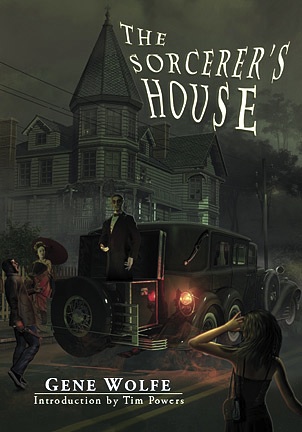
 ) and was nothing but disappointed, though this again might have been down to false preconceptions: the publishers were selling it as “Wolfe does Lovecraft-meets-Blade Runner“, but once I’d finished it, I realised it read more like “Wolfe does fifties screwball comedy, with SF bits”, which is quite different. But I couldn’t be bothered to re-read it with that new interpretation in mind just to see if I was right. Recently, though — the thing that kicked off this blog post — I read his latest, The Sorcerer’s House, a short fantasy novel put out by PS Publishing in the UK, and really enjoyed it (I put a review up on Amazon.co.uk
 for that one, too). And I enjoyed it because I applied what I’d learned about how I should be reading Gene Wolfe, rather than trying to “read” his reputation.
So, here’s what I learned.
 The unreliable narrator. When I hear about an unreliable narrator, I mostly expect to meet someone who’s lying through their teeth. But such a narrator would be impossible in a novel — their word, after all, is the only way you’ve got of knowing anything, so the author would have to be inhumanly cunning to let us know, with every word, both what the narrator is saying and what the truth is, if the two are so diametrically opposed. The best unreliable narrators are the ones who just occasionally don’t quite tell the whole truth for some reason, usually because they’re unaware of it themselves, rather than because they’re being outrightly deceptive. Kazuo Ishiguro’s first two novels, A Pale View of Hills and An Artist of the Floating World are excellent examples (but he completely lost me with When We Were Orphans, a real disappointment). Both of those novels’ narrators are unreliable, but only in that each has a single “blind spot”, a thing they can’t quite admit to themselves (and about themselves — the best literary “blind spots” are self-blindnesses), but which the reader comes to see, despite the narration. So, instead of the “big unreliables”, like lies, unreliable narrators are best for subtle dramatic ironies. It’s a whole different game with SF & fantasy, of course, where the narrator is often telling a story set in a world that’s so unfamiliar you have no way of judging whether what they’re saying is true or not, and you have to place that much more reliance on them. Unreliable narrators in SF & fantasy are a lot more tricky. The key to Wolfe’s narrators, I think, is this passage from “Tracking Song”:
“You know nothing. You are like a child who has wandered by accident in a theatre a half minute before the final curtain. You see people moving about, some masked; you hear music, observe actions you do not understand. But you no not know if the play is a tragedy or a comedy, or even know whether those you see are the actors or the audience.”
This sums up the standpoint of many of Wolfe’s narrators: they’re “unreliable” mainly because they know so little. Sometimes they’re full-on amnesiacs, putting them in exactly the same position as the reader (knowing nothing about the world, or the situation, they suddenly find themselves in is just like starting to read a new story); sometimes they’re children, who have an excuse for not knowing everything (Henry James thought a child to be the perfect narrator, because they were highly observant and curious, but too innocent to understand the full implications of what they see happening around them) or newly-released prisoners (who see the world in a whole new way, too, and often, having been out of it for a while, need to have some basic facts explained); sometimes they’re just plain innocent or unworldly, like Able in The Wizard Knight who, though he has the body of a man, is still basically a child in mind. Sometimes his narrators glimpse hints that point to things so large they can’t understand them — and the reader, necessarily, is in the same position. Generally, with SF and Fantasy, we’re used, as readers, to having wonders hinted at, then revealed or fully explained later on. Wolfe sometimes just does the hinting, and leaves it at that. It can leave you frustrated, but if you accept it as wonder for wonder’s sake then you get just as much bang for your buck: those half-answered, or unanswered, questions are part of Wolfe’s worlds, just as they’re part of ours. In this sense, the unreliability of Wolfe’s narrators really points to a deeper honesty about our inability to know everything in our own lives.
That “dense, allusive prose”. I don’t think Wolfe’s prose is particularly dense. In fact, it’s quite cut back and simplified, almost Hemmingwayesque. It’s what Wolfe’s leaves out that gives it its depth. Of the Wolfe books I’ve read, “density” could most properly be applied to Severian of the Guild, where he uses archaic words to evoke the strangeness of the world he’s describing. But even then, he generally only uses exotic nouns. The meanings of his sentences are quite clear, they’re just given an alien tinge by having, for instance, a helmet referred to as as burginot, or a trumpet as a graisle, and you can often guess the rough meaning of the noun by its context, without having to resort to a dictionary if you don’t want to. It’s similar to Clark Ashton Smith‘s weaving of a “verbal black magic” of archaic words to conjure the feeling of Never Never Land antiquity. On the other hand, “allusiveness” is a vital part of Wolfe’s style — the things he leaves out, or hints at but doesn’t fully explain. But this has always been a part of SF and fantasy writing, ever since Robert A Heinlein wrote “the door dilated” — an unexplained background detail that (literally) opened a portal through which the reader could imagine an entire futuristic world. Wolfe just takes this to the next level.
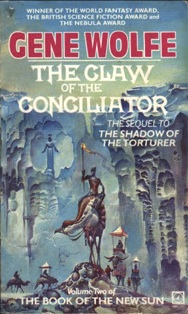
 Story jumps. This may be what I found so off-putting, initially, about The Wizard Knight. The Wizard Knight is set in a fantasy world based on the cosmology of Norse Myths, where there are several layers of reality co-existing, with human beings living in Mythgarthr (Middle-Earth), above which is Skai, where dwell the godlike Overcyns, and below which is Aelfrice, land of the Aelf (elves). There are other worlds further above and below. At several points in The Wizard Knight, Wolfe’s hero, Able, slips through from one reality to the next, often quite suddenly in the midst of some action on the human level. The trouble is, like most traditional visits to Elfland, time in Aelfrice and Skai passes at a different rate, and when Able returns to Mythgarthr, he can find that years have passed, and whatever action he was involved in has moved on. This is quite dislocating for the reader, particularly if you’re used to the traditional, step-by-step methods of fantasy novels. But, even though this can be jarring, it turns out to be essential to the story Wolfe is telling — the way he has rationalised the very weird Norse cosmogony in The Wizard Knight is one of the truly impressive things about the book. Which is why I want to go back and read it again, now I know not to be irritated by those sudden breaks in the story. Elsewhere — as in the narrative gap between the end of The Shadow of the Torturer and the start of the next book in the sequence, The Claw of the Conciliator (and have there ever been better names for fantasy books?) — it’s more difficult to defend the leaps in the narrative, except to say that, although they seem overly artificial when you come across them, they nevertheless work, when you look back on them. But that’s something I’m finding in my reading of Gene Wolfe: sometimes I only realise how much I enjoyed a book of his once I’ve finished reading it. In the midst of things, it can seem a bit more challenging.
Playing with significances. If you bring the more explicitly storytellerish elements into your writing, they inevitably make it seem there are hidden levels to what you’re doing. I’m talking about the stock ingredients of fairy tales — things like doubles, orphans, princes & princesses, kings & queens, magic rings, hidden treasures, quests, and so on. Of course, these do actually bring in hidden levels to the stories they’re used in, but that’s not down to the writer using them — they come ready-charged with an aura of significance and meaning thanks to their archetypal resonance with the imaginative unconscious.
Some writers, though, manage to create their own “stock ingredients”, and once you begin to encounter them again and again, you begin to feel something’s going on. Ballard is an obvious example, with his recurring surrealist motifs like drained swimming pools, dead astronauts and low-flying aircraft. Wolfe is another, though not in as blatant a way as Ballard.
Here’s some recurring Wolfe motifs:
- Roving theatrical groups, often run by a doctor or professor. (And often the protagonist is recruited into the play with very little rehearsal. This happens in Severian of the Guild, and two stories in The Island of Doctor Death and Other Stories and Other Stories.)
- Caches of ancient technology underground; also, immensely powerful creatures hidden underground.
- Characters from literature (often children’s fantasy literature, or pulp literature) appearing in dreams or waking visions (“The Eyeflash Miracles” uses The Wizard of Oz in this way, “Houston, 1943” uses Peter Pan, “The Island of Doctor Death and Other Stories” uses invented pulp characters).
- Werewolves, and wolves generally. I wonder why…
- Genetic alterations, often gone decadent or wrong.
- A distant future appearing like the archaic past — a post-technological society with remnants of technology. (This becomes an extension of the unreliable narrator — the narrator is effectively a primitive in a world of wonders, which we, as readers, can see as technology.)
- A resonance with Christ’s story.
- Duels with unusual weapons.
But if you find yourself encountering such elements in a writer’s work, does that mean there’s something going on that you have to interpret? I don’t think the use of motifs like this is necessarily a conscious decision on a writer’s part. They may become conscious of them, but only because they find them popping up, time and again, and are content to enter into a happy collusion with their imagination — something I find in all the fantasy writers I most enjoy. But it’s not a difficulty; rather, it’s an added pleasure.
 Dialogue. This is my one remaining sore point with Wolfe. There’s a lot of dialogue in Wolfe, which is good, and most of it reads quite well. Sometimes it has a spikyness that reflects the genuine disjointedness of real-life conversations. But sometimes it slips into mannerisms that can be quite annoying. This was particularly evident in An Evil Guest, a book I no longer have, otherwise I’d be able to provide an example of it. But it would go something like this. Wolfe would bring two characters together and one would say something like: “I’m going to ask you a question. But first I need to make two points.” Then the other would say, “I’ll answer your question. In fact, I think I know what’s going to be. But then I’ll have two questions of my own.” Rather than just asking the questions, they’d do all this introductory dialogue (which seems rather too much like an author planning out the scene to come). This may seem like a minor quibble, but once I noticed it was going on, it became quite irritating. I wanted to grab Wolfe’s characters and give them a shake. “If you’re going to say it, just say it!” Dialogue seemed to become a method of retarding the plot, rather than moving it forward. But my inability to find a good, convincing example of it is perhaps evidence that it wasn’t as prevalent as it was annoying.
So that’s it. My Secret Method for reading Gene Wolfe. Which is that really, there’s no secret at all.
The thing that brought it all together for me was an interview with Wolfe on StarShipSofa, where he said that the SF writer who had most influenced his style was Theodore Sturgeon. I really like Sturgeon, and have no difficulty reading him. He’s a writer who, like Wolfe, is strong on ideas, and not afraid to go in for some stylistic experimentation, but primarily he’s a gutsy writer, and reading him you’re never in any doubt that what’s driving his writing is feeling. Suddenly having these two writers, Wolfe and Sturgeon, associated in my head made me realise that my approach to Wolfe had been fundamentally wrong. I’d been thinking of him as an intellectual writer, and trying to read him as though his stories and novels were the literary equivalent of crossword puzzles, with me looking for clues that would lead to some sort of solution. But fiction isn’t a puzzle with a reductive solution; the story is the puzzle and the solution in one. Reading Wolfe as a storyteller, not a puzzle-maker, was, in this case, the secret I was looking for.



 , published in 1926 (1927 in the US, as A Blade for Sale), is usually regarded as the exception among