…the biological equivalent of a machine gun, hideous in its perfection. Alien. [William Gibson’s description of a wasp’s nest, from Neuromancer.]
 As a sort of followup to my previous look at Anthony Powell and Ursula Le Guin’s script for an Earthsea film, I thought I’d look at another un-produced film script by a favourite author: William Gibson’s go at Alien3. It’s odd to think, given the William Gibson we have now — author of three trilogies of literary techno-thrillers set in a series of progressively closer futures — that he might once have been considered the obvious candidate for an Alien script. The draft that’s out there on the internet (I got mine here) is apparently an early one, Gibson’s first ever go at a movie script, for which he only had the scripts for Alien and Aliens as a guide. (According to Gary Westfahl’s book on Gibson

It starts with the Sulaco — the spaceship carrying Ripley, Newt, Hicks and Bishop at the end of Aliens — straying briefly into the territory of the Union of Progressive Peoples, a clear USSR-analog, considering the fact that they exist in an uneasy nuclear standoff with the “capitalist cartels” that include the Weyland Yutani corporation, and the fact that their people have names like Suslov and Lenko. The UPP board the Sulaco, lose one man to a face-hugger (Gibson gets the alien action in quickly — a face-hugger and full-size creatures within the first few pages), then depart with android Bishop’s upper body, before letting the Sulaco drift on, to be picked up by the space station Anchorpoint (“the size of a small moon”). Anchorpoint supposedly has no military or Company loyalties — it’s populated by what the Company’s Milisci division dismiss as “idealists”, “liberals”, and people with “a certain antipathy to Military Sciences”, in other words ordinary citizens — but the Company have been wanting this bio-weapon since Alien, and they’re not going to let anything get in their way. The trouble is, as they soon realise, the UPP have probably got the alien, too, and it’s at this point the script seems most of its era: the UPP and the Company both suspect that the other is going to develop the alien for potential use as a weapon, therefore the only thing to do is develop it themselves just to keep up. A biological arms race begins. And, with the alien creature as technology rather than just a movie monster, this seems far more like William Gibson territory.
Gibson reworks the alien, stripping it back literally to its DNA. In one scene, we get to see how a strand of alien bio-matter wraps itself around human DNA and transforms it instantaneously. (In a nice touch, a microscope shot of alien bio-matter reveals how its micro-structure echoes the macro: its “lines and textures recalling the interior of the derelict ship in ALIEN.”) Suddenly, the alien is not just the creature we’ve encountered in the previous two films, it’s a virus that works at the genetic level. Gibson’s “New Beast”, as he calls it, doesn’t emerge as a chest-burster, but as a full-person burster, ripping off its human host like the Hulk rips off a shirt. And it’s not only humans who get the alien-DNA-bonding experience. Gibson gives us an alien lemur, primates strung up with Giger-goo awaiting “the change”, and even an alien-ised cabbage.
Yes, an alien-ised cabbage:
Two of the Styrofoam structures have been overgrown with a grayish parody of vegetation, glistening vine-like structures and bulbous sacs that echo the Alien biomech motif. Patches of thick black mould spread to the styrofoam and the white deck.
HICKS: It was… cabbages or something…
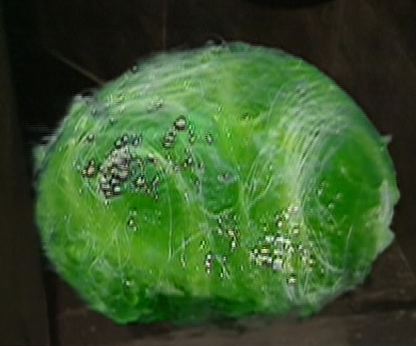
My favourite alien cabbage, the Rutan from the Doctor Who story, The Horror of Fang Rock
Back in the UPP, before the aliens escape, Gibson has one of his pseudo-Soviets speculate on the technological nature of the aliens:
SUSLOV: Perhaps it is the fruit of some ancient experiment… A living artefact, the product of genetic engineering… A weapon. Perhaps we are looking at the end result of yet another arms race…
(Which chimes in nicely with the direction Ridley Scott took the franchise in with Prometheus.)
For about half the script, Gibson’s Alien3 brushes against the sort of futuristic Cold War techno-thriller that’s more his kind of thing. Then the alien breaks free in both the UPP space station and Anchorpoint, and we’re where we expect an Alien film to be: a race to escape from the base before it self-destructs, but on a larger scale than the previous two films. Gibson sticks to the Alien and Aliens formula, but uses his new, viral version of the alien to provide some interesting riffs on what we’ve already seen (including a man turning into an alien while in a space-suit, and an alien chase in the vacuum outside the space station).
Ripley is all but absent, waking up only to see an alien and become instantly catatonic. Newt, too, is seemingly there for continuity’s sake alone. (She gets shipped off to Earth before the aliens escape. And Ripley is jettisoned in a lifeboat while still comatose, so she can return for a sequel.) The main stars of this version of Alien3 are Hicks (the surviving marine from Aliens) and Bishop.

The script has a few signature moments of laconic description from Gibson the hard-boiled techno-writer and futuristic beatnik: “The cubicle, terminally sloppy, resembles the nest of a high-tech hamster.” “His office is furnished in the best futuro-Pentagon style…” “…his smile a heartless display of state-of-the-art enamel-bonding techniques”. A chest-burster is “suspended there like an eyeless fetal dolphin”. Best line of all, though, has to be: “The Aliens tear into the Marines like living chainsaws.”
At the end, Gibson opens the way to further sequels by having Bishop suggest it’s time to stop running from the aliens, track them down to their source, and wipe them out:
BISHOP: This goes far beyond mere interspecies competition. These creatures are to biological life what antimatter is to matter.
He even suggests this might be a way to end the Cold War:
You’re a species again, Hicks. United against a common enemy.
I quite like Gibson’s Alien3. Had it been made, it would have been more what people expected from the franchise, though its transformation of the aliens from large-scale creatures to a sort of genetic virus would have ramped up the pace of future films to near Apocalyptic proportions — suddenly, anything could at any moment turn into an alien version of itself. And with Newt (infected?) already shipped off to Earth, and Ripley drifting yet again in a lifeboat, you can see how an Alien 4 might map out.
According to David Giler (on the making-of documentary on the Alien3 Blu-Ray), they got Gibson to write the script because they were expecting a lot of good ideas that could then be formed into a proper film script, but what they got, in his opinion, was “a perfectly-executed script that wasn’t all that interesting.” I can see what he means, in that Gibson toes the line of the previous two films, rather than providing the sort of game-changing wild ideas you might have expected from this happening, hip new writer. But this expectation may have been down to misunderstanding just what it was that was happening and hip about Gibson. He wasn’t — and isn’t — a machine for transforming genres, although that may have been how he was perceived at the time; he’s a writer who’s best at doing his own thing, who just happened to transform a genre (SF, cyberpunk) on the way.