
 Although she’s more well-known nowadays for her modern-Gothic/psychological suspense novels such as Rebecca (1938) and My Cousin Rachel (1951), both of which have been filmed several times, Daphne du Maurier produced some good shorter fiction that can be classed as weird, supernatural, or science-fictional — in a couple of cases all three at once — some of which have also been filmed, including The Birds (by Alfred Hitchcock in 1963), Don’t Look Now (by Nicolas Roeg in 1973), and The Breakthrough (adapted for TV in 1975, and then filmed as The Lifeforce Experiment by Piers Haggard in 1994).
Hitchcock said that, when adapting, he would read the book or story once, then never look at it again, and it can seem that, with his film of The Birds (scripted by Evan Hunter), it’s only the basic idea of mass bird attacks on humans that the two have in common. Du Maurier’s story (in The Birds and Others, 1952) is set in rural Cornwall and has a male working-class protagonist; Hitchcock’s is set in Bodega Bay, north of San Francisco, and has a female upper-class lead. But there are moments of similarity, including a bird attack on school children, and a visit to a neighbouring farm where the farmer is found pecked to death. Both end without any solution or explanation. I’d say, though, that the roots of du Maurier’s story are more evident, in the way it draws so many parallels with the then still-recent Second World War. Her story is full of scenes of the family huddled round a wireless set, tuning in for news from the authorities, or blocking out the windows just as they’d have blacked them out during the war. As the bird attacks increase, the family bed down together in the kitchen, just as they might have in an air-raid shelter, and the wife says, “Won’t America do something? … They’ve always been our allies, haven’t they? Surely America will do something?” The main character thinks about the birds as he would an enemy army (“A lull in battle. Forces regrouping.”). At the end, as the attacks continue and the authorities struggle to do anything, it’s as though the state of how things were in the Second World War has somehow seeped out from the human world to become the natural order.
 None of these are short stories — du Maurier preferred novella length, it seems — meaning that even when she’s working at an idea another weird-fiction writer might turn into a quick twist story, she explores it at greater depth. An example of this is “The Apple Tree” (also from The Birds and Others), about a man who can’t help being a little relieved at the death of his eternally hard-done-by wife, but who starts to notice a resemblance between a stunted tree in his garden and his late wife’s slouched posture, after which he suspects she’s using the tree to haunt him. It’s an idea that’s been used before (Lovecraft’s “The Tree”, for instance), but writing it at length, du Maurier really brings out the relentlessly stifling nature of the marriage, and the desperate futility of the husband’s attempts to find some joy in life now he’s no longer burdened by such a negative spouse. The supernatural element is just the icing on the cake — the final twist to a man who’s already haunted in a purely psychological sense.
Difficult marriages feature in a lot of du Maurier’s tales, and her own was, it seems, troubled at times. There were affairs on both sides (in Daphne’s case, with both men and women), and the couple seems to have been happier living apart — he in London, where he worked after his military career (he became Treasurer to the Duke of Edinburgh), she in Cornwall. When her husband had a nervous breakdown, Daphne, learning he’d been having an affair, decided to do her best to save the marriage, but soon found the loss of creative solitude brought her to the edge of her own breakdown. Writing her next collection, The Breaking Point (1959), was her means of recovery.
 Two of its stories stand out, for me. In “The Blue Lenses”, a woman who’s had an operation to implant new lenses into her eyes wakes to find she sees everyone with animals’ heads in place of their own, and seemingly the more she cares for them, the worse the head. (Her husband has a vulture’s.) It’s an unconventional idea for a horror story, at first absurd, but du Maurier quickly builds up the sense of inescapable isolation as her protagonist finds herself unable to hide her horror at what she sees. “The Pool”, meanwhile, is about a girl spending the school holidays with her brother at their grandparents’ house, for whose extensive garden she has an almost mystical reverence. She sneaks out at night to perform made-up rituals to bind herself, once more, to the garden, and to the strange world she can access through a pool in a thicket of trees. It reminded me of Arthur Machen’s “The White People”, which is also about a girl drunk on her own mix of nature-mysticism and fairy lore. But du Maurier brings in an element Machen, I think, never would, as this heady mix of fantasy and weirdness is linked to the girl’s first period. (I wonder how transgressive this was for a book published in 1959? Other stories in the same volume deal with pederasty, incest, madness, and the disposal of a dead baby — all of which, I can’t help feeling, must have felt incredibly shocking at the time.)

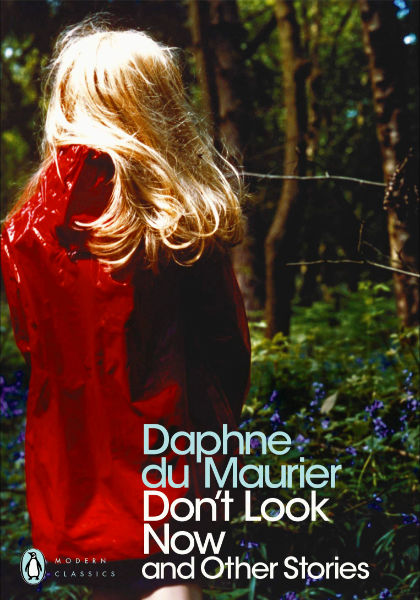
Penguin paperback cover, art by Dave and Sue Holmes
For me, du Maurier’s most satisfying single collection is Don’t Look Now and Other Stories (which came out in 1971, initially as Not After Midnight). It’s a collection dominated by recent deaths and troubled mourning, with three of its five stories being about people dealing with grief.
“Don’t Look Now” has a disturbing circularity to its plot. Its main character has unacknowledged clairvoyant powers, and his own death only occurs because he has a vision of what happens as a result of that death. If he hadn’t seen it — if he’d not looked now — he wouldn’t have died. It’s quite a subtly-balanced tale, and I have to admit it’s one I don’t think (though I may be the only person who thinks this) works as well in Nicolas Roeg’s film, which brings even more ambiguities to a story that’s rich enough in them already. Writing of du Maurier in The Penguin Encyclopedia of Horror and the Supernatural, Gary Crawford says “All du Maurier’s tales are symbolic and elegant, but they are less terrifying than simply strange, almost in the manner of Robert Aickman.” I don’t think du Maurier is often as outright surreal as Aickman, but “Don’t Look Now” may be her at her most dreamlike.
(And there’s a scene in the 1940 film of Rebecca, where the sinister Mrs Danvers urges the new Mrs de Winter to fondle her predecessor’s clothes, which seems straight out of Aickman’s “Ravissante” — only, of course, preceding it by nearly three decades.)

For a writer I most closely associate with Rebecca and the black & white Hitchcock/Selznick film based on it, “The Breakthrough” (which is copyrighted 1966, though I haven’t been able to find if it appeared before its inclusion in Don’t Look Now and Other Stories [but see addenda below]) feels very modern — or 1970s-modern, anyway. An electrical engineer is sent to help with an experimental government project to develop the use of sound as a weapon, but whose leader has co-opted the project to investigate what he calls “Force Six” — essentially, the sixth sense, and its possibility of providing “the explanation of telepathy, precognition, and all the so-called psychic mysteries.” This project leader, James MacLean, also believes that “Force Six” is released as pure energy when we die. Unconcerned with the idea of “souls”, MacLean believes that by trapping and using that energy, “We shall have the answer at last to the intolerable futility of death.”
This mix of secret research, up-to-date electronic gadgetry, and psychic phenomena recalls Nigel Kneale’s The Stone Tape (1972) and the episode of The Omega Factor (1979) which was also about the military use of sound. (And I can’t help wondering if it was one of these that inspired Kate Bush’s “Experiment IV” (1986), also about the military use of sound.) It’s a satisfying tale, and the BBC2 adaptation (which you can watch on YouTube), is a good take on it.
 Daphne du Maurier’s short story/novella output is quite varied, ranging from crime to satire to some outright strangeness (as with “The Lordly Ones” from The Breaking Point in which — I can’t be sure — a boy runs away from his indifferent parents and is briefly adopted by some ponies). My favourite non-fantastic story of hers is, I think, “The Way of the Cross” (from Don’t Look Now and Other Stories), in which a mismatched bunch of pilgrims visit Jerusalem and suffer their own betrayals, redemptions and resurrections in the space of a hectic twenty four hours. But overall my favourites are, of course, the weird ones, and generally those that have been adapted: “The Birds”, “Don’t Look Now”, “The Breakthrough”, and, among the un-adapted, “The Pool” and “The Blue Lenses”. I think a good single-volume collection could be made from her weird fiction, but perhaps they’re better left where they are, as the strangeness of her strange tales seems all the stranger for being couched amongst her other, more normal — though never mundane — stories.
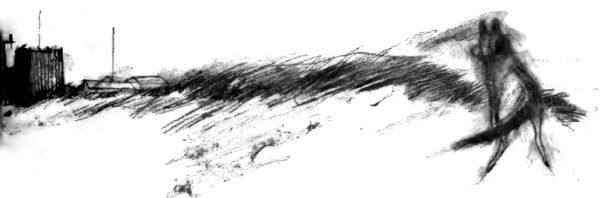
Illustration to “The Breakthrough” by Marbury Brown, Ladies Home Journal, March 1966
Addenda: “The Breakthrough” was first published in The Ladies Home Journal, March 1966, with some suitably sixties-style illustrations by Marbury Brown. You can see some not-great scans at Archive.org here. Meanwhile, du Maurier’s weird fiction has been collected into a single volume, After Midnight (2025), with an introduction by Stephen King that you can read here.


