Stranger Things

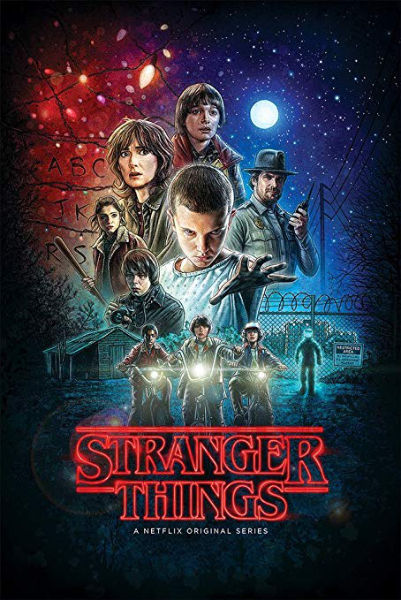
Stranger Things season 1 poster by Kyle Lambert

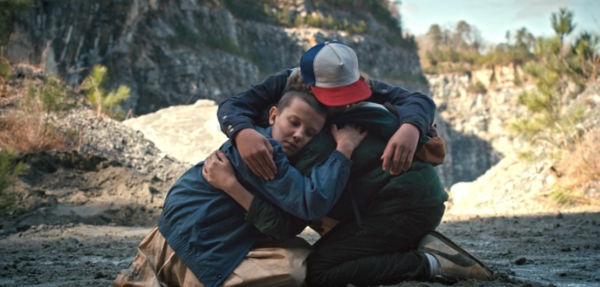
Although the most obvious (and avowed) influences on Stranger Things are the early works of Steven & Stephen (Spielberg and King), I think the real core of the show’s success comes from a less obvious direction, and one not rooted in the show’s celebrated evocation of the 1980s. Because, for me, the impact of Stranger Things comes not from nostalgia but from its depiction of childhood, both as a time of extreme vulnerability to the darker forces of the world (as experienced to the greatest degree by the characters of Will and Eleven), and of imaginative engagement in the world’s wonder & strangeness (the D&D boys, whose Dungeons-and-Dragoning has perfectly prepared them to deal with a world of monsters, parallel dimensions, and mind-powered super-kids). Innocence, in our post-Game of Thrones era of TV where cynical, self-interested characters are the norm, and are often the shows’ heroes, is a very rare quality, perhaps because it’s so difficult to do convincingly (without lapsing into sentiment or mere victimhood, for instance). But when it is done convincingly — and when it’s brought face-to-face with real darkness — it has genuine power. The most obvious recent example I can think of, and the thing that feels, to me, closest in many ways to Stranger Things’ success (including its reliance on a very talented young cast), is the Harry Potter films.

This is perfectly brought out by another Netflix series, the German-made Dark (from 2017), which at times seems like it was created as a result of someone describing Stranger Things (perhaps down a crackly phone line) to Werner Herzog in one of his more sombre moods. It contains many of the same elements of Stranger Things: missing children, a small-town setting, a sinister government scientific establishment where science-fictional experiments seem to be going on, a link to the 1980s (Dark opens in the present, but some episodes are set in the 80s, and there’s a strong generational link to that decade), supernatural travel between two realms, flickering electric lights, abandoned railway tracks through woodland, and your by-now-standard emotionally damaged police detectives. But whatever the similarities, the differences in tone are polar. Dark, for instance, has plenty of montage sequences in which we see various characters isolated in states of lonely misery, with the occasional couple hugging in a desperate need for solace, all backed by the more dour kind of pop song. (Stranger Things does do this, when a body is removed from the quarry lake and Peter Gabriel’s version of “Heroes” plays in the background. But Dark seems to do it at least once an episode, and not as a moment of dramatic climax, more as a feeling that this, in the world of Dark, is what daily life feels like.)

Dark (which, at the moment, I still haven’t finished watching, so it may change) is all about how people are fundamentally isolated from one another, and how everyone picks up dark secrets and emotional wounds as they enter adult life, which further isolate them and undermine their attempts at relationships. Stranger Things (which I’ve now watched twice through in the time it’s taken me to get halfway through Dark) is about the complete opposite: how facing darkness can bring people together, and how the way to overcome the darkness is, ultimately, to break through the barriers of isolation and make human connections (most obviously, for instance, in Eleven’s learning to trust other people after her horrendous upbringing at the Hawkins National Laboratory, but also in the way memories of kindness are used to break through the Shadow Monster’s control of Will in season 2). Stranger Things’ catchphrase is, after all, “Friends don’t lie.” I’m not sure if Dark has a catchphrase. It’s a show that’s more about silence; perhaps its image of dead birds falling from the sky would serve.
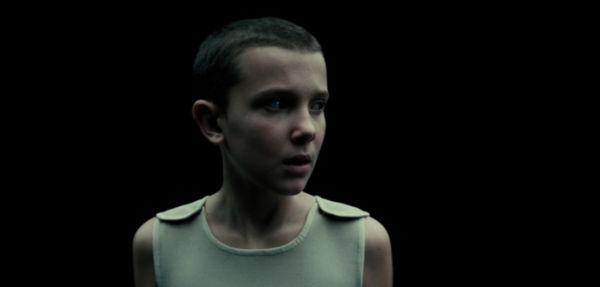
Having said that, I do think Stranger Things’ darkness is properly convincing. On first watching it, my initial impression was that someone had made a list of all their favourite scenes from 70s and 80s horror and kids’ adventure movies, particularly of the Spielbergian variety, and arranged them into a workable story. But then I realised the show’s creators were using those scenes’ existing associations to give them an interesting twist, usually taking them in a more disturbing direction. Even when the reference seems just a subtle joke — as when Mike, Lucas and Dustin dress Eleven in a blonde wig, echoing the way, in ET, Eliot’s sister dresses ET in a blonde wig — it can’t help adding an emotional resonance. ET in a wig is funny because it’s a ridiculous image; Eleven in a wig underlines the fact that she’s been treated throughout her young life as somewhat less than a human being (her shaved head and number tattoo have obvious associations with Nazi concentration camps), which has left her as much an alien in our world as ET was. There’s a palpable sense that, in looking through Mike’s sister’s bedroom, or being dressed in a play-box blonde wig, she’s been given a tiny glimpse of the upbringing she was denied.

The sort of darker twist I mean can be seen in another ET parallel. In Spielberg’s film, when Eliot’s mother comes home while Eliot is showing the alien his Star Wars toys, Eliot has ET hide in the closet, which becomes a joke when his mother looks in the closet, sees ET, and assumes he’s just another toy. In Stranger Things, when Mike and El are at Mike’s house (he’s showing her his Star Wars toys) and his mother comes home, Mike has El hide in the closet but she’s terrified, as it reminds her of the isolation cell her “Poppa” Dr. Brenner would lock her in if she didn’t do what he wanted. The scene feels that much darker for being an echo of ET’s light comedy.
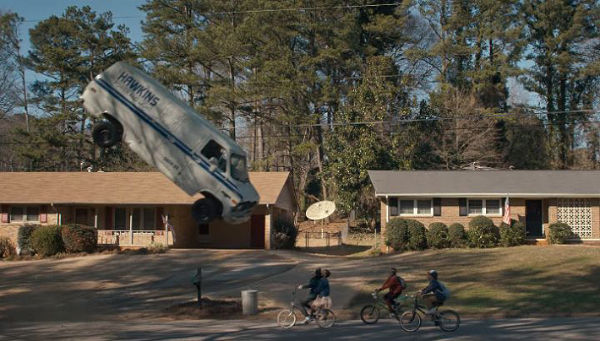
The best parallel, for me, was another ET swipe, when the kids, reunited after the first season’s quarrels, are escaping from the “bad men” of Hawkins National Laboratory on their bikes. In the equivalent scene in ET, when it looks like the kids are finally cornered, ET uses his powers to lift them into the air so they can fly away, still pedalling. It’s the film’s signature wonder-moment. In Stranger Things, a much more down-to-earth and practical El lifts an oncoming government van and throws it at their pursuers. ET is an alien temporarily stranded on our world; El is a young girl forced to become a weapon by government “bad men”.

The theme of innocence brought up against darkness is at the heart of many of my favourite films, and certainly the ones that affect me the most, including Hitchcock’s Shadow of a Doubt, Del Toro’s Pan’s Labyrinth, David Lynch’s Twin Peaks: Fire Walk With Me, and the more recent book & film of A Monster Calls. (Another favourite, Amelie, contains no supernatural darkness, but is still about an innocent, in this case a young woman facing the much more mundane darkness of loneliness. In fact, Alien is about the only one of my top favourite films I can’t fit into the innocence-versus-darkness theme, but perhaps that’s because it’s even more primal, being about sheer survival.) Anyway, Stranger Things (seasons 1 & 2) certainly grabbed me in the same way, and I hope it manages to keep some of that innocence going in future seasons.
^TOP

Close Encounters of the Third Kind

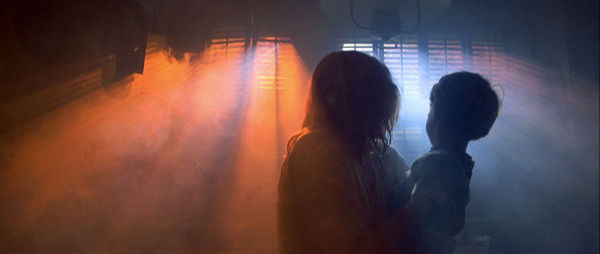
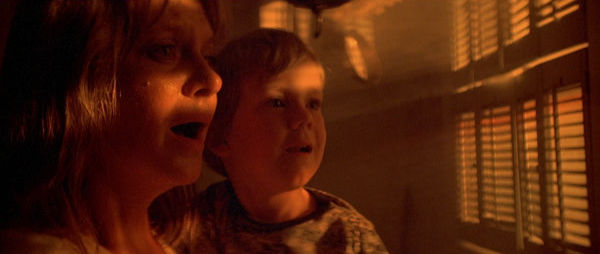
Just what is the aliens’ plan in Close Encounters of the Third Kind? We know they’ve come to Earth in the past and kidnapped a random selection of people — some of them military personnel, others just ordinary folks — along with, in the military cases at least, their vehicles. Now they’ve come back, but to do what, exactly? First, they leave those captured vehicles in random, out-of-the-way places, such as a ship in the middle of the desert. Then they zip down from the skies and buzz aircraft or swoop along US highways, causing all sorts of poltergeist-like electrical disturbances as they go, including shutting off the power to whole towns (including hospitals?), incidentally causing skin burns in those who see them too close, and resulting in at least one policeman crashing through a road safety barrier and down a (fortunately not too steep) incline beyond. They kidnap a child whilst terrorising its mother; they induce a mental breakdown in the lead male character who, as a result, loses his job and then his family.

The odd thing is that, throughout, everyone seems to feel this is all to some ultimately benevolent end. Roy (Richard Dreyfuss) wants answers, and Jillian (Melinda Dillon), who had her child ripped from her hands after having a selection of kitchen knives thrown at her, wants her child back, but both seem more angry at the government for refusing to admit anything’s happening, than at the aliens, who are the cause of it all.

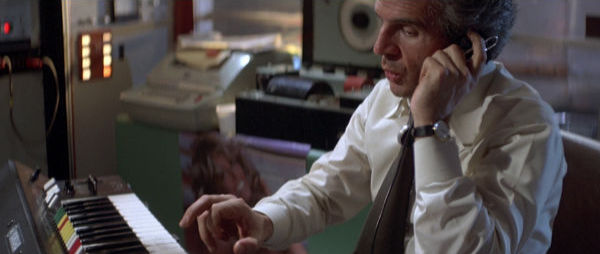
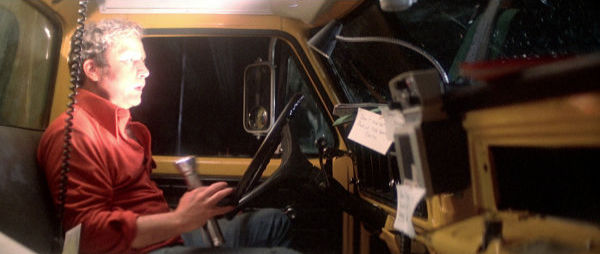
And what do the government know, anyway? (And it’s not just the treacherous post-Watergate US government. At some significant meeting before the film begins, it’s said to have gone very well for the French in some way, meaning François Truffaut’s Claude Lacombe is in charge of the whole official response. His speaking French to the US military and government implies that the difference between their attitude and his is a question of people speaking, metaphorically as well as literally, entirely different languages.) The most the government seem to do is rush around ticking off vehicles as they’re returned, and listening to a crowd in India enthusiastically chant a five-note melody then pointing at the sky. Associating this melody with a series of hand signals gets Lacombe a round of applause, as though translating this message from one abstract form to another were some sort of breakthrough. Later, while the other government scientists are getting excited over the idea that a series of numbers being beamed at them from somewhere within the solar system might be map coordinates, Lacombe shouts at them to listen, then once again picks out the five-note melody, as though he’s only just discovered it.

This welter of strange phenomena — electrical disturbances, lights in the sky, sunburn at night, random kidnappings, lost military vehicles reappearing in desert locations, obsessive visions of a mountain landmark, a five-note musical sequence — feels like one of those “terminal documents” J G Ballard’s near-to-breakdown protagonists from The Atrocity Exhibition insist on making: fragmented lists of specific-but-random images or objects they nevertheless assert “all make up one picture”. (At one point, Roy, tearing apart his and his neighbour’s gardens for raw materials to build a living-room-sized sculpture of Devil’s Tower, says, “You ever look at something and it’s crazy, then you look at it another way and it’s not crazy at all?”) Like The Atrocity Exhibition, and Garner’s Red Shift, Eliot’s The Waste Land, and Wilson’s The Outsider, Close Encounters is crisis literature, but it’s not an individual going through a crisis, it’s an entire world, even though it occurs as much at a domestic as an international level. (Roy’s wife, Ronnie (Teri Garr), on the poltergeist-levels of disruption of Roy’s UFO obsession: “It’s turning this house upside down.”)

Heaven or Hell?

But where does it all lead? What are the aliens doing? It’s as if they’ve come, not to reassure humanity there’s a greater power up there in space that’s looking after them — they’re not, it turns out, the sort who disarm our nuclear weapons and wag an extraterrestrial finger at us, as in The Day the Earth Stood Still — but, rather, they’ve come to reassure us that the world is far stranger than we’ve become used to. Our world, the aliens seem to want to say, is capable of turning upside down, of breaking apart, of having things disappear then reappear thirty years later for no apparent reason, of having the sun come out in the middle of the night, of interrupting your normal, humdrum life with disruptive artistic visions, devastating losses, and wonder-inducing bright lights. One of the government men says, at one point, “There’s so much we don’t know.” He, it seems to me, is the one who sums up the aliens’ message. Not that they’re some vast benevolent force who are going to intervene in the course of human history and save us from ourselves, but, rather, that they’ve come to remind us of chaos — creative chaos, but disruptive and often painful chaos all the same — to remind us that this is what life’s about. Unpredictability. Incomprehensibility. Then they go away, taking another human with them, as though to say, “Don’t think this is over.”

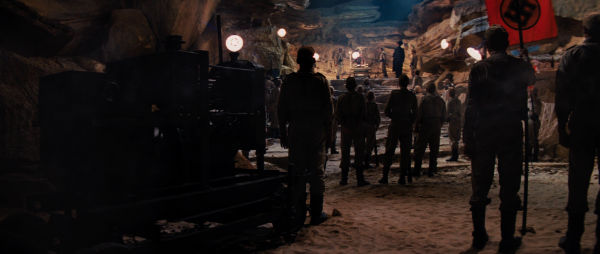
Raiders of the Lost Ark – a Nazi film crew

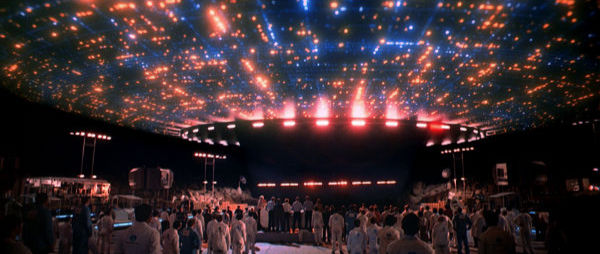
Close Encounters – a government film crew

The end of Close Encounters (1977) is oddly similar to the end of Raiders of the Lost Ark (1981). In both cases, we have a remote, rocky location where a film crew — an actual film crew in the case of the Nazis in Raiders, a government crew of scientists in Close Encounters, though one equipped with a host of cameras, bright lights, and even a musical instrument, therefore much closer to a film crew than your usual group of government scientists (it’s even, to underline the analogy, presided over by a real-life director, François Truffaut) — attempt to record the unrecordable: a meeting with the supernatural. (Which ties both films in with all those ghost stories where scientists try to understand the supernatural with a host of electrical measuring devices, as in The Stone Tape or The Awakening.) Clouds gather, and wonder-inducing lights weave among the watchers — angelic ghosts in the case of Raiders, UFOs in the case of Close Encounters — before the main visitation itself. This, of course, is where the two differ. In Raiders, the angels turn to demons and everyone who’s been watching gets melted, burned, or zapped; in Close Encounters, everyone gets a milder-comeuppance: a dose of benevolent awe and bewilderment. The worst that happens is a window gets shattered and a man has to rush to the toilet.

An adult’s fear, a child’s wonder. Which is the right reaction?

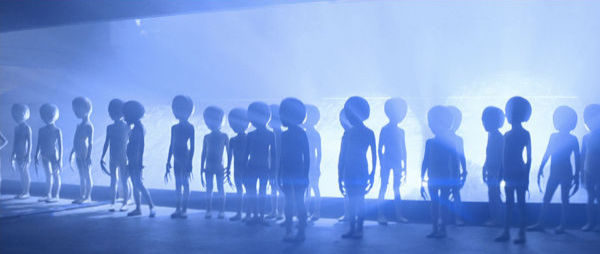
The key to Close Encounters is probably in the way the kidnapped child reacts to it all. He’s not scared of all that poltergeist activity (just like the young girl in Poltergeist (1982), in fact) — the eerie wind-up monkey that springs to life in the middle of the night, the vacuum cleaner that begins hoovering the carpet on its own, the kitchen knives that launch into the air — he just accepts it as part of how the world is, sometimes. (He also almost gets run over by standing in the middle of a bend in the road. Childlike wonder is no defence.) And the aliens themselves, even those who aren’t child-sized and child-proportioned, look more like childish drawings, with ill-shaped potato heads, round starey eyes and shapeless mouths, can’t-be-bothered-to-draw-it-right long-fingered hands and vague, oval bodies. “It’s like Halloween for grown-ups,” says Jillian, in the early days of waiting for the UFOs to reappear. Lacombe, shouting, “Écoutez”, as he picks out a five-note melody on his toy keyboard, and who brandishes crude paintings as evidence before the military, is like a child who insists on taking his own games as seriously as the adults take things like bills and work and national security. But, at the same time as all this child-like wonder and awe, there’s also a feeling of childish self-involvement which, however unintentionally, hurts others. It all starts to feel a little like that Star Trek plot where the god-like alien is just about to kill the crew of the Starship Enterprise when his parents turn up and tell him to stop being such a naughty boy. Are we dealing with grownup aliens, here? They certainly don’t behave that way.

Close Encounters is, at its most boiled-down, a film in praise of awe and wonder. Made as it was in a post-Watergate, post-1960s age of increasing cynicism, it duly acknowledges the adult complications of awe and wonder: mental breakdown, paranoia, governmental attempts to return things to a point of control and secrecy, and the possibility of real, irrevocable loss on a human level. But ultimately it waves its hands over those things. We see Roy ascending to the skies like a child being taken, finally, to the ultimate Disneyland; we don’t see his wife and children living with the aftereffects of his breakdown and abandonment. Also, perhaps too obviously, it’s about the most cinematic aspects of awe and wonder: bright lights, close-ups of wide-eyed human faces, strange and awful things you’ve never seen before (and wouldn’t really want to see, outside of a cinema), and wonderfully convincing special effects.

^TOP

The Morrow Books by H M Hoover

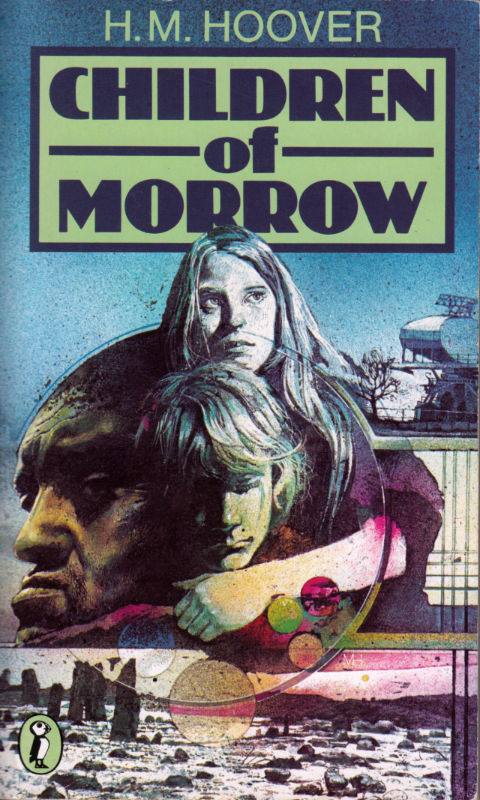
Cover to 1987 Puffin UK version, art by Michael Heslop

Tia and Rabbit are a little bit different from the other children at the Base, a primitive hunting and farming culture lorded over by the Major and the other Fathers (any man who sires a child is admitted to the upper ranks), who worship the relics of the ancient past, chief among which is a missile in a silo under their “church”. It’s an utterly repressive society, and a life of endless toil and constant fear of punishment for any transgression against the Major’s whims. Tia, though still a child, is taller than most of the other women and men at the base, though she gets breathless more easily; Rabbit, a younger boy, stammers. The two have shared a connection ever since Rabbit fell down a hole in the woods outside the Base’s grounds, and Tia, somehow hearing his cries for help, knew exactly where to find him. Ever since, she’s been branded a witch by the superstitious-minded people of the Base.

And, it turns out, she sort of is. She and Rabbit share dreams in which they talk to Ashira and Varas, a man and woman living in a far different community called Morrow. The Morrowans are telepathic, and survived the ecological “Destruction” of the past (which began with the “Death of the Seas”, during which 93% of all living creatures died of suffocation) thanks to the foresight of Simon Asher Morrow, who created a subterranean complex into which he and his chosen few could retreat while the Earth recovered. Tia and Rabbit can communicate with Ashira and Varas because they too are telepathic, and when Rabbit’s nascent mind-powers result in him killing one of the more abusive Fathers in Tia’s defence, the two children flee the Base and, guided by Ashira and Varas but pursued by the Major and a handful of hunters, make their way down a hundred miles of river to meet the Morrowans on the coast of what was, many years ago, San Francisco.

(The writing really comes alive, I think, when the children encounter things on this journey they at first can’t understand — a ruined and overgrown city, for instance, or the sea, whose strange, distant noise and smell puzzle them at first.)

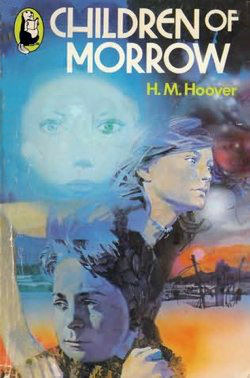
Beaver Books, cover by John Raynes

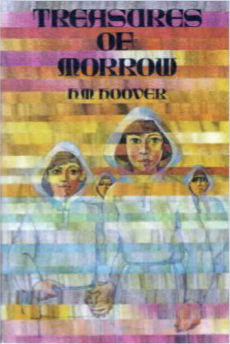
Helen Mary Hoover’s Children of Morrow was first published in 1973, and has much the same scenario as John Wyndham’s The Chrysalids, though the emphasis is less on that book’s struggle to keep its child protagonists’ telepathic powers secret, and more on the post-discovery chase and rescue. Unlike Wyndham, though, Hoover returned to the world she’d created with Treasures of Morrow (1976), a book that starts right where Children of Morrow ends, meaning the two can be read quite satisfyingly as a single story.

In Treasures of Morrow we get to see Tia and Rabbit’s journey to Morrow and their assimilation into a culture completely alien to them because of its technological advancement and its capacity for kindness. After this, Tia, Rabbit, Ashira, Varas and some other Morrowans go on an expedition back to the Base, and Tia and Rabbit get to look at the grim, unforgiving and brutal culture in which they were raised with fresh eyes:

“Did I ever look like that?” Tia wondered as she stared at them. At this distance, in their still pose, the women’s faces were blurs, one indistinguishable from the other. All had the same wild, tangled hair. All wore the same sacklike brown leather dress. Their feet and arms were bare and muddy. But it wasn’t their bedraggledness that bothered her so much as their hangdog air of subjugation. She had not been so aware of it before, and seeing it now, and remembering, disturbed her.

Although there’s less plot and less urgency to Treasures of Morrow (there’s still a tense, action-filled ending, but it feels a little less desperate than the first book’s, thanks to the comforting presence of the technologically-advanced and cool-thinking Morrowans), to me the second book feels a bit more emotionally satisfying. Revisiting their abusive childhood world, Tia and Rabbit get to see it for the sad, demeaning tragedy it is. They can even feel pity for their abusers, seeing many of them as doing the best they could in pitiless circumstances, or simply acting out of unthinking ignorance. Ultimately, they have to turn their back on the Base, but seeing it again, now they know a better alternative, allows them to properly leave it in the past.

Although it might sound like Morrow and the Base are being presented as moral opposites, Hoover makes it clear that Morrow isn’t entirely a utopia. It was founded by one of the very industrialists whose greed caused the ecological Destruction in the first place, and who did so out of the desire for personal survival rather than an ideological investment in humanity’s future. And a potted history of Morrow in the aftermath of that mass extinction makes it clear how close it came to falling apart, with a slow deterioration of its power structures, and the enforced inbreeding of its limited population. A contamination of its main protein supply led to a chance evolutionary leap, killing some, but resulting in a few children being born with telepathic powers, after which a strict programme (still adhered to) of controlled breeding led to their present state of all being telepaths. There’s still a hint, in Treasures of Morrow, that Morrow is in danger of cultural sterility, due to there being no other equivalent civilisations to interact with:

“I mean, we’re smarter than any of the old civilisations. But there’s no one else to care what we are—or do. For example, my sister, Elizabeth, says the neutron star in the Crab Nebula is winking out. Once that news would have excited astronomers all over the world. Now it excited about six people.”

Helen Mary Hoover

It would be interesting to read a third book on how Morrow deals with this situation — something Tia and Rabbit, raised in a different culture, might have a vital perspective on. It also seemed, in Treasures of Morrow, that one of the Morrowans, Senior Geneticist Elaine, was being set up to act as a Morrowan villain, with her coldly scientific attitude towards the people of the Base, and her disapproval of Tia and Rabbit. She accompanies the expedition to the Base, but pretty much fades from the narrative, except to make the occasional offensive comment, but I felt she had the potential to underline the sort of extreme Morrow might go to, if it ever lost touch with its humanity.

There’s also the question of Tia and Rabbit’s origins. In Children of Morrow, we learn they’re the result of an unauthorised experiment in artificial insemination by a Morrowan who happened on the Base, though even the Morrowans who discover the diary describing this incident agree it sounds unlikely. It sounds as though the Morrowans have a dark side to their nature they’re perhaps not confronting. So, plenty of potential for a third book, but as it is, the two we have feel complete, so far as telling of Tia and Rabbit’s escape from an unpleasant childhood goes.

I bought the first book because of the UK edition’s Michael Heslop cover. Treasures of Morrow doesn’t seem to have been published in the UK in paperback, so perhaps the first wasn’t as successful over here as the publishers were hoping. They’re both now available for Kindle.

^TOP