Astercote, The Whispering Knights, The Wild Hunt of Hagworthy by Penelope Lively

Astercote by Penelope Lively, cover by Neil Reed

Astercote by Penelope Lively, cover by Neil Reed

In Astercote (1970), when a chalice known only as ‘the Thing’, which is supposed to have protected the village of Charlton Underwood from the Black Death in medieval times, goes missing, the modern-day villagers begin to cut themselves off from the outside, and chalk white crosses — indicators of infection — on houses where people are showing the slightest sign of being unwell. In The Whispering Knights (1971), three children, bored in their school holidays, boil up a witches’ brew (or the closest they can get to it — ordering frogs’ legs from a London shop, for instance, but having to use drawings for some of the more hard-to-obtain ingredients, like the wing of a bat) in a barn supposedly once inhabited by a real witch, and manage to bring themselves and their village to the attention of an increasingly baleful supernatural presence. In The Wild Hunt of Hagworthy (also 1971), a new vicar (‘Frightfully nice man — full of ideas’) decides to revive the quaint old Horn Dance of Hagworthy as part of a fête to raise money for the church roof. But the Dance is linked with the far more ancient and powerful Wild Hunt, which isn’t something any of the village oldsters want to see revived.

The Whispering Knights by Penelope Lively, cover by Neil Reed

The Whispering Knights by Penelope Lively, cover by Neil Reed

Penelope Lively’s first three books for young teens are characteristic of a type of British YA fiction in the late 60s and early 70s (as well as the TV shows of the time, like Children of the Stones, or The Changes), mixing Famous Five-ish ‘what we did on our holidays’ adventure with touches of 1960s kitchen sink realism and incursions of the folkloristic supernatural. The Whispering Knights is the most Famous Five-ish, with the characters feeling a little light and cartoonish, and the adventures being mostly episodic. (It’s also the most explicitly supernatural of the three.) The Wild Hunt of Hagworthy, on the other hand, has the most realistic development of its two lead characters, with the slightly withdrawn Lucy Clough and the rebellious Kester Lang both feeling like proper teenagers. And, in both The Wild Hunt and Astercote, the supernatural is more a psychological force than an external one, working through people’s superstitions and prejudices more than through actual manifestation. (Though manifestations do occur.)

At the heart of each book is an abuse of something traditional and sacred, something tied to the village as a continuing way of life, but also to the dark, dangerous forces of superstition and the supernatural. This means there’s an odd tension in each story, with the sacred thing — be it an object, such as the chalice in Astercote, or a practice, like the Horn Dance in The Wild Hunt — needing at once to be preserved, and to be hidden away or suppressed; protected for the village, and from the villagers.

The Wild Hunt of Hagworthy by Penelope Lively, cover by Yvonne Gilber

The Wild Hunt of Hagworthy by Penelope Lively, cover by Yvonne Gilbert

In both Astercote and The Wild Hunt, the sacred thing is abused for financial reward (even if, in one case, it’s for the repair of a church roof). In The Whispering Knights, it’s the children’s playing at witchcraft that feels like an abuse, even though it isn’t done for gain; afterwards, with the witch Morgan on the loose, it’s village life itself that comes under threat, when the newly-embodied witch marries a local factory owner, and gets a proposed motorway’s route altered to take it straight through the centre of the village. At first, the children who summon Morgan are told that she thrives on superstition, and that their best weapon against her is reason; later, it’s their very belief in her — that she represents a supernatural threat, rather than just a physical one — that means they can combat her in the proper way, and so save their village.

If there is a right way to deal with the sacred in these three books, it seems to be to revere the idea of it, while keeping the reality hidden away. This is most obvious in the attitude of Kester Lang’s uncle, the blacksmith of Hagworthy, towards the Wild Hunt. On the one hand, he says:

‘It were a great thing, once, the Hunt. Nothing to be afraid of. It were a splendid thing…’

But, at the same time, it was ‘not for a man to look on with his eyes’:

‘Because once you seen them you’re a part of them, aren’t you, girl? You’re with them under the same sky and treading the same ground. And they’re a Hunt, aren’t they? They have to hunt something, or someone, don’t they?’

This ambivalence may explain what I found to be the main fault of the first two books (and present in the third, but not as a fault), in that, in each case, once it was obvious, quite early on, what the problem was — a missing chalice, a summoned witch — the teen protagonists don’t really do anything, but sit around watching events unfold, and only right near the end suddenly clock that some action needs to be taken. The Wild Hunt has a similar delay, but in this case the time when nothing happens is used to build tension and deepen the characters’ relationships. Perhaps it’s significant that in this book the building supernatural tension causes a split between the two main characters, Lucy and Kester, and they have to heal that rift before they can act, together, against the supernatural.

Red Shift by Alan GarnerThis idea of a threatened sacred ‘thing’ (chalice, village life, dance) reminds me of the similar ‘sacred thing’ in Alan Garner’s novels — usually a nonsensically-named, apparently worthless but in fact deeply important object which comes to stand for a precious relationship, or a person’s identity, or the sacredness of the landscape itself — but in these three of Lively’s YA books, this ambivalence, this need to treat the sacred as both easily endangered and supernaturally dangerous, adds an interesting layer of complexity, even if it isn’t explored as deeply as in Garner’s novels.

The teens in these late-60s/early-70s ‘folk-fantasy’ style YA books are liminal creatures, existing on the border between the past and the future, tradition and progress, rational knowledge and irrational imagination, just as they’re hovering on the verge of adulthood. They listen to the old folks’ superstitions and take them seriously; they believe in the strange things they themselves see and hear; but they also believe these things can be changed, challenged, and faced, which (usually) the overly superstitious old folks don’t.

There’s a real feeling in these books (both Lively’s and others of the time) of being at an important cultural crossroads, with the possibility of genuinely sacred things being put at risk from a galloping, money-minded modernity, severing life from the quiet meaningfulness symbolised by village life, while also needing to take a properly rationalistic attitude towards the prejudices and superstitions of the past. It’s not, in any of these books, a clear-cut choice, and all of them end with a feeling of real peril as the forces of the irrational are let loose in a series of wild hunts (be they motorbike gangs, ancient witches in modern limousines, or stag-antlered faerie men with green-flame-eyed dogs) across stormy but beautifully-described landscapes.

To me, there’s something haunting about that cultural crossroads. Is it just nostalgia on my part? Or was there something genuinely sacred — some idea or ideal — which was lost in a battle with modernity midway through the 1970s?

(I was prompted to read these three novels after listening to The Heartwood Institute’s two albums inspired by them, both available at Bandcamp, The Wild Hunt of Hagworthy, and Astercote.)

^TOP

Night Visitors by Julia Briggs

Night Visitors, Julia Briggs’s 1977 study of ‘The rise and fall of the English ghost story’, employs a bit of (potentially fatal) boundary-blurring early on, first as regards the term ‘ghost story’:

‘It may be apparent that the term ‘ghost story’ is being employed with something of the latitude that characterises the general usage, since it can denote not only stories about ghosts, but about possession and demonic bargains, spirits other than those of the dead, including ghouls, vampires, werewolves, the ‘swarths’ of living men and the ‘ghost-soul’ or Doppelgänger.’

NightVisitorsThe second bit of boundary-blurring regards the term ‘English’, as she includes Irish (Sheridan Le Fanu and Oscar Wilde), Welsh (Arthur Machen), Scottish (Robert Louis Stevenson), American (Henry James and Vernon Lee), and French (Guy de Maupassant) writers in her study. (And if Henry James is excused because he was living in England, what of Kipling, who was living in India?) What makes this so potentially fatal is that her thesis — that the ghost story, as a form, is dead, indeed ‘has become a vehicle for nostalgia, a formulaic exercise content merely to recreate a Dickensian or Monty Jamesian atmosphere. It no longer has any capacity for growth or adaption.’ — and her reasons for it, can perhaps only be taken to apply to the strictly defined ghost story, and perhaps only the English version of it, certainly not the breadth of weird fiction she covers in this study. After all, when the book was published, a horror boom was in full swing, with not only countless anthologies of old ghost and horror stories being published (driven, no doubt, by Hammer’s popularity in the 60s), but also horror novels hitting the bestseller charts for perhaps the first time since Dracula, thanks mostly to Stephen King, but helped by a Brit or two (James Herbert, Ramsey Campbell). So it seems Briggs’s argument should be that the purely English, purely literary, purely ghostly, purely short story may have become moribund, but that the rest of what was taken in by the boundary-blurred remit of her survey was booming.

There is another way to look at it, perhaps only possible now the book is over four decades old. This is that the ghost story achieved a brief and uncharacteristic literary relevance to the fin-de-siècle and Edwardian eras, then stepped back into the crypt of popular, generic fiction where it had always lurked, and where it remains to this day. And what, I’d say, Night Visitors is good for is its look at this brief foray into literary respectability, and why this phase came to an end. (Which perhaps also answers why it came about in the first place.)

So, why did it end?

In short, Freud and the Great War:

‘The Great War had not only trivialised invented horrors by comparison, it had also catalysed changes in society which affected the ghost story less directly but no less fundamentally. Atheism and agnosticism were now more widely tolerated, and totally materialistic philosophies were far commoner than heretofore. The rigid conventions of sexual behaviour which had influenced middle and upper class attitudes, began to be flouted more openly… Now the unconscious itself had become the subject of close scientific scrutiny rather than the more philosophic, often more amateur speculation of the previous century.’

NightVisitors_backSupernatural stories, at the end of the Victorian Age and into the Edwardian, achieved a new relevance and richness thanks to their exploration of the darker areas of human psychology that, after the World Wars, were more explicitly addressed using the newly-accepted scientific terminology of psychoanalysis. (Though some, between the two World Wars, like Blackwood, went to the opposite extreme and used the technical language of the occult.) The ‘psychic doctors’ of Le Fanu, Blackwood and Hodgson had been replaced by psychoanalysts, and the only recourse for the popular ghost story was a retreat into formal conventions, achieving a sort of final perfection in the hands of M R James, who:

‘…did not share the concern shown by other writers (Blackwood or Le Fanu, for instance) with the significance of spirits, the state of mind in which ghosts are seen, or the condition of a universe that permits the maleficent returning dead.’

But Briggs nevertheless finds certain writers who continued to make meaningful use of the ghost, each in their individual way. Elizabeth Bowen, for instance, whose 1945 collection The Demon Lover ‘reveals her ghosts as somehow necessary to their victims, occupying spiritual voids left by the shock of war.’ Or Walter de la Mare, in whose work ‘death has taken over the role which love traditionally plays in fiction, as the most central and significant experience of life…’ She doesn’t mention Robert Aickman, but he’s an author, I’d say, whose ‘strange stories’ — the closest thing the ghost story came to a reinvention in the 20th century — were enabled, not negated, by Freud.

Meanwhile, the 1970s, when Night Visitors appeared, had a definite tendency to render its horrors in gaudy, gory, sensationalistic cinema, often rendered as fleshily physical as the censors (and the special effects) would allow. The psychological subtlety of the ghostly tale, as championed by Briggs, was perhaps not so much dead but drowned out.

Julia Briggs, interviewed for a 1995 documentary, A Pleasant Terror: The Life & Ghosts of M.R. James

Julia Briggs, interviewed for a 1995 documentary, A Pleasant Terror: The Life & Ghosts of M.R. James

The fundamental human experiences that ghosts, as literary devices, were used to explore, though — secrets, repressions, guilt, loss — remain, and always will. Those dark, cobwebby corners of the psyche can’t have been entirely exorcised. So how were they addressed when the ghost story was superseded?

Modern psychological thrillers, whose killers are too often endowed with near-supernatural abilities, provide similar grounds for exploring the darker regions of the psyche. People may not be haunted, but they are stalked. Detectives and criminal profilers try to get into the minds of the killers they’re tracking, as though working on the assumption that these psychos are their own, personal Doppelgängers. The wrenching twists and revelations of a story like Gone Girl — a ghostly title, surely — may not be spiritual, but they tick the other boxes in the formula Briggs provides for what the ghost in the ghost story represents:

‘…the eruption of the tip of the spiritual iceberg, the sudden sense of the existence of previously unknown modes of being that undermined and ultimately invalidated a comfortable confidence in the world of appearances.’

All of these are ghostly tropes, remade for a disbelieving age. (A pity they don’t work as well, for me. I need that hint of the weird, it seems.)

Briggs finishes her study by saying:

‘That bulging, cobwebby box which had so long been clamped down to prevent its terrors escaping has at last been opened, to reveal nothing at all…’

And it’s true, nothing’s there. But that’s probably because he’s standing behind you, with a knife.

^TOP

Sky

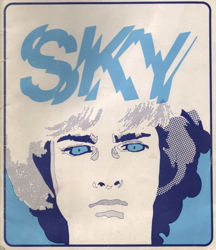
SkySky (first broadcast in 1975) manages to tick just about every box in the 70s kids’ TV checklist: standing stones, the next step in human evolution, psychic powers, Merlin, magic, advanced technology masquerading as magic, warnings about mankind’s over-reliance on technology, environmentalist predictions of coming disaster, even a hint of class tension.

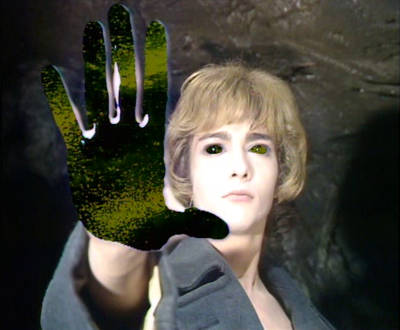
It starts with the blue-eyed, golden-haired alien Sky (and if he looks a bit like an Axon, perhaps that’s because the show’s writers, Bob Baker and Dave Martin, wrote The Claws of Axos for Doctor Who) appearing in the middle of an English forest, only to be immediately attacked by the surrounding greenery. Found by young Arby Venner, the leaf-smothered Sky pleads: “Take me away from living things.”

An alien and far-future time-traveller, Sky has missed his intended era, and now finds himself rejected by the very life-force of a world he does not belong to. Begging to be taken to “the Juganet” (“The Juganet is a circle. The circle is a machine. The machine is a crossover point. The point is a paramagnetic intersection. That is where I must be.”), which he can use to jump to the correct time, he claims (when asked by Arby’s sister, Jane) that despite his seemingly helpless state, “I suppose, in your terms, I am to be a god.”

Sky_03

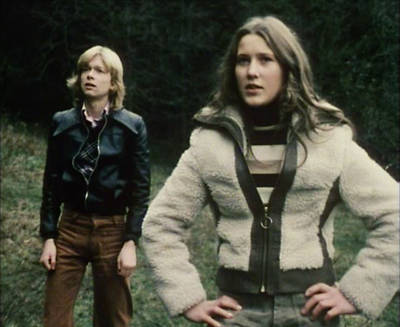
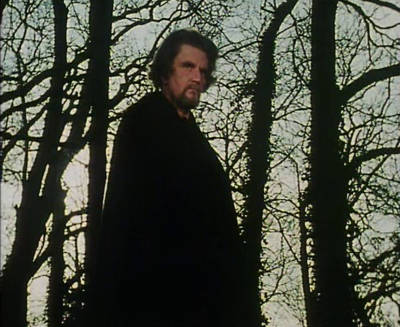
Meanwhile, the “animus of the organism” — the riled life-force of our world — manifests itself as the black-cloaked Ambrose Goodchild, whose purpose is to track down and do away with this unwanted alien by any means, be it by summoning more smothering greenery, or posing as a surgeon so he can operate on him. Arby, Jane, and the slightly posher boy next door, Roy Briggs, do their best to help the importunate Sky, despite having no idea what he’s on about most of the time.

Luckily, there’s a mad Welshman to hand. (And that’s another 70s kids’ TV box checked: mad Welshman who knows.) Old Tom may be touched in the head (“He’s supposed to be simple.” “No. It is you who are complicated.”), but he can hear Sky’s thoughts and see Sky’s telepathic pictures, and he once visited a place that looks like this Juganet thing, though he can’t recall where, or what, it was. So Arby and Jane borrow their dad’s Land Rover (they’re late teens: Arby drives a Land Rover and Roy’s got a motorbike), kidnap mad Tom and the hospitalised Sky, and take them on a jaunt to Glastonbury Tor. Which, it turns out, isn’t the Juganet, but is getting close.

Sky_02

Sky is a bit like E.T. Only, whereas E.T. isn’t above a little emotional bonding while he tries to phone home, Sky is only interested in his human helpers when he wants rescuing. Once he’s recovered, he wants to be left alone so he can find the Juganet and leave this age that he knows only — and ominously — as “the Decline”. His task is to help humankind after “the Chaos”, not before it. As far as he’s concerned, before it, we’re beyond help.

Sky is, it seems, intended as a chastening reminder that our modern age is but one tiny step — and, most likely, a mis-step — on its way to some future evolution we can’t even begin to appreciate. He believes “It is the destiny of all intelligent beings to stand outside space and time,” and that modern man’s mistake is to “believe in machines”:

“You do not reach the stars with rockets, any more than you invent radios by shouting at the sky.”

Goodchild, on the other hand, seems even more reactionary:

“…the way to intelligence is the way to destruction… You have made man an alien. An alien force throttling life on this planet.”

Sky_06

Sky could almost be a prelude to The Changes, shown at the start of the same year (Sky was ITV, The Changes BBC). The coming “Chaos” could be the “Changes”, in which a Merlin-like force (Goodchild’s first name, Ambrose, links him with Merlin) initiates a UK-wide revolt against machines. Both shows seem to be both rejecting hippie back-to-nature idealism (Sky is taken in, briefly, by a hippie couple awaiting a mystic traveller foretold in the prophecies of Merlin; he repays their kindness by disillusioning them, then attracting enough creeping greenery to destroy their caravan), while also wagging the finger at our love of technology.

What happened between the 1970s and the 1980s, when the whole idea of technology as a step too far seems to have been quietly dropped? (As were standing stones, and mad Welshmen.) There’s a real feeling that these 70s kids’ TV shows — Sky, The Changes, to a lesser extent The Moon Stallion — were grappling with issues that aren’t to be found in their 80s equivalents (The Moon Dial, Elidor, The Box of Delights), which were just as, if not more, magical in content (no more technology masquerading as magic, though — it was pure magic all the way), but don’t seem to be addressing social issues beyond the coming-of-age adventures of their protagonists. And so, while perhaps those 80s shows are that much more timeless, they don’t necessarily have the unity, depth, and cultural relevance of the best of the 70s ones. Or is that just my own nostalgia?

^TOP