Time for a Doug McClure triple bill! Once upon a time, it seemed you could always catch a Doug McClure, a Ray Harryhausen Sinbad, or George Pal’s The Time Machine on a Sunday afternoon. As a kid, I watched them all, religiously, each and every time they were repeated — to the extent that, once, my dad had to set up a black & white portable telly in the car so my brother and I could watch At the Earth’s Core as he drove us back from visiting our Gran & Grandad in Selsey.
Writing about Tom Baker in Nicholas and Alexandra a few mewsings ago led to me wanting to watch one such film, The Golden Voyage of Sinbad, again, and that urge led to me buying the whole Harryhausen Sinbad trio and watching the lot. (Golden Voyage remains my favourite, with Tom Baker the best Sinbad sorcerer-villain, and Kali the coolest Harryhausen monster.) That led to the even stranger urge of wanting to watch a Doug McClure film or two. I say “even stranger” because, well, at least with the Sinbads, I knew the monster sequences would stand up to a re-watch, but even as a kid I knew the monsters in those 70s Doug McClure films were not exactly convincing. Still, the urge was there, and The Doug McClure Fantasy Adventure Triple Bill box-set called…

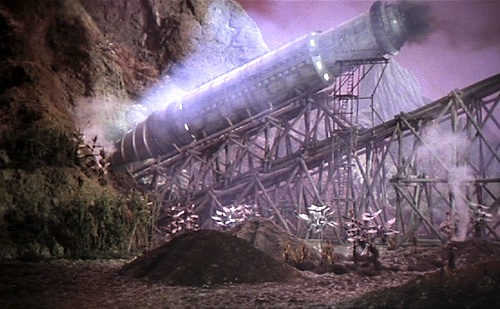
The Land that Time Forgot was the first. Released in 1975, based on the 1918 Edgar Rice Burroughs novel, it starts with a German U-Boat torpedoing a civilian vessel, from which only a handful of survivors escape. Among their number, of course, is the heroically-chinned Doug McClure, who immediately sets about organising a rowboat attack on the Germans. What I didn’t know about this film all those many times I watched it as a kid was that it was scripted by Michael Moorcock and James Cawthorn. And the script is one of two things that really stands out in this film — the story develops at a good, even pace, with it being a full half hour before there’s even a hint of the fantasy element to come. Before that, it’s all about the tension between the British and Germans as they struggle to gain or regain control of the U-Boat. And the good script goes hand in hand with the other plus point that makes this the best of the three films in this box-set: the actors. Like so many British films (such as the Harry Potter films nowadays), even the minor roles are taken by faces you know or half-know from British TV and films. Here, we have Anthony Ainley (later to play the Master in 80s Doctor Who) and Susan Penhaligon (who played Lucy in the 1977 BBC adaptation of Dracula — the best adaptation of the novel, in my opinion), to name just two.

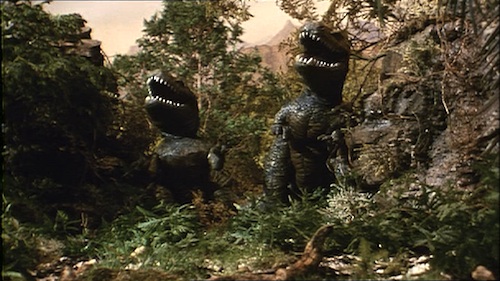
It’s only after that half-hour of tussling for control of the U-Boat that we get a brief shock-glimpse of the first of the film’s monsters. This, the one element that got me watching these films as a kid, is the part that least stands up now, but it’s not the total disaster I was afraid it’d be. In The Land that Time Forgot, the monsters are mostly puppets, and when they’re on their own, while they wouldn’t ever be described as convincing, they’re at least not bad, as long as you enter into the spirit of things. It’s when they do what Harryhausen does so well — a battle between humans and monsters — that things don’t go so well. The dinosaurs of The Land that Time Forgot have a tendency, when fired upon, to just stand there roaring and waving their paws until, after a tedious back and forth between roaring monsters and firing humans, the monsters cave in and fall over (usually rather stiffly). It’s almost as if, as puppets, they know there’s a line they can’t cross, and their human prey are on the other side of it. There are a couple of examples of life-size props being used in human-monster fights (a pterodactyl taking a neanderthal in its jaws and gliding woodenly away, a bendy-necked lake dinosaur jabbing at Doug McClure), but the monsters are always at their most effective in short bursts. The trouble is, the film tends to milk them a little too long. (That first, very brief, appearance of a lake monster lunging at the U-Boat’s periscope is the best monster moment in the film, if not the entire box-set.)

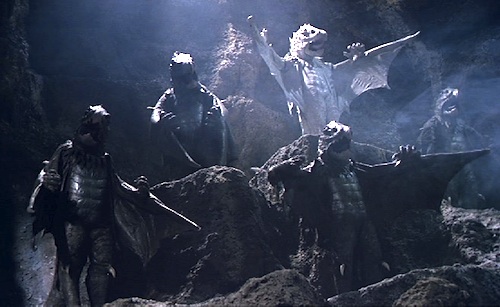
At the Earth’s Core, another Burroughs adaptation, was released in 1976, and this, perhaps because it’s studio-bound, has much more of a period feel. Here, there’s barely ten minutes build-up before we’re in the lost world of Pellucidar, with its glaringly artificial pink light and its drastic step backwards in monster effects: for the puppets have been replaced by men in suits, complete with stiff but rubbery-flappy taloned feet and dry wobbly rubber tongues. But Earth’s Core is less of a serious affair, with Peter Cushing playing a stiff-backed professor almost like a reprise of his earlier take on Doctor Who (for the same studio, Hammer’s rival, Amicus). Meanwhile, there’s a lot more action, which means a lot of rather dull fights between square-chinned Doug and an array of thuggish men in varying degrees of masks & make-up.

This, really, is how Edgar Rice Burroughs should be adapted. I know there’s a big-budget version of A Princess of Mars in production at the moment, and I’m sure its CG Barsoom will look brilliant; all the same, there’ll always be a part of me that feels Burroughs is better served by this style of slightly naff effects, by-the-numbers acting, and general air of filmic pulpiness.
If The Land that Time Forgot worked pretty well as a film, At the Earth’s Core is at least fun. We’ve got Peter Cushing’s comic turn, Caroline Munroe giving us a twirl, and the malevolent Mahars… I don’t know what it is about these reptilian super-parrots with their stiffly blinking eyes and complete rubber-suited lack of grace, but they still have an air of menace about them. Plus, they explode when they die!

Between At the Earth’s Core and the next film in the box-set, Warlords of Atlantis, everything changed. Earth’s Core was 1976. Warlords was 1978. And in 1977, of course, there was Star Wars. As a result Warlords of Atlantis was not an Amicus film, nor was it predominately British in cast. It also had a proper budget behind it, which meant some pretty good sets and plenty of location work. What it didn’t mean, though, was better monsters. We’ve still got the men in suits. The suits are slightly better (with more reptilian warts, if nothing else), and they are, also, occasionally doused in water, which makes them a little bit more realistic, but some of them — particularly the four-legged ones — move with less grace and realism than a pantomime horse, and the humans-versus-monsters sequences are still a question of cutting between shots of the humans firing guns and the monsters standing back and roaring. If this is how the dinosaurs behaved, it’s no wonder they became extinct.
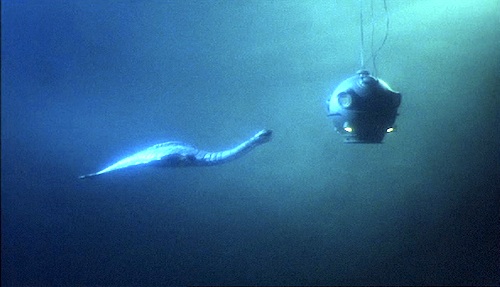
Ah well. But at least there was a surprise waiting for me in the credits. The screenplay was written by Brian Hayles, who provided some classic Doctor Who scripts, including The Celestial Toymaker, The Ice Warriors, and the two Peladon stories, as well as writing a number of Target novelisations. And the plot of Warlords could well be a repurposed Doctor Who submission, with Atlantis the remnant of a destroyed planet, hidden on Earth, kidnapping mariners (by use of a giant octopus) to use as slaves to repair and defend their crumbling, once-great cities. The Atlanteans themselves have mastered such mind-powers as levitation and being able to see into the future, but nothing, nothing, nothing can prepare them for the mighty chin and fist of Doug McClure. He socks them good, and they go down.
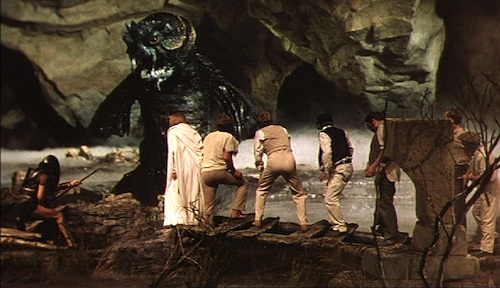
Warlords of Atlantis is the only original (non-Burroughs adaptation) of the three. It’s also, despite its bigger budget — or perhaps because of it — the most disappointing. Perhaps because the nice sets and glittering costumes hint at the better film that could have been made if only they hadn’t stuck to the men-in-rubber-suits philosophy, or perhaps it’s just that the pulpy man-fights-Empire-with-his-bare-fists storyline was so much better suited to a low-budget, creaky-effects approach than something that looked as though it had, at last, seen the light of Star Wars. (The monster sounds are a lot better, which helps. Perhaps that was a Star Wars influence.)

Overall, the films are enjoyable, pulpy, adventurous fare. Perhaps it’s because I grew up watching them, but I was more than happy to make allowance for the naffness of the effects as long as the storylines were working. In a way (and I want to write a mewsings on this at some point), I prefer effects that are obviously artificial — not necessarily creaky, but stylised, artful, like Ray Harryhausen’s Kali. They give an air of magic, of something other than reality, and call for an imaginative response from the viewer which super-dooper CG lets you all-too-easily opt out of.
There was another Amicus Doug McClure film, The People that Time Forgot, in 1977. I can’t say I’m quite inspired to track it down and actually pay to see it, but if it comes on TV again, some idle Sunday afternoon (not that I have many of those anymore), I’m certain to watch it.