
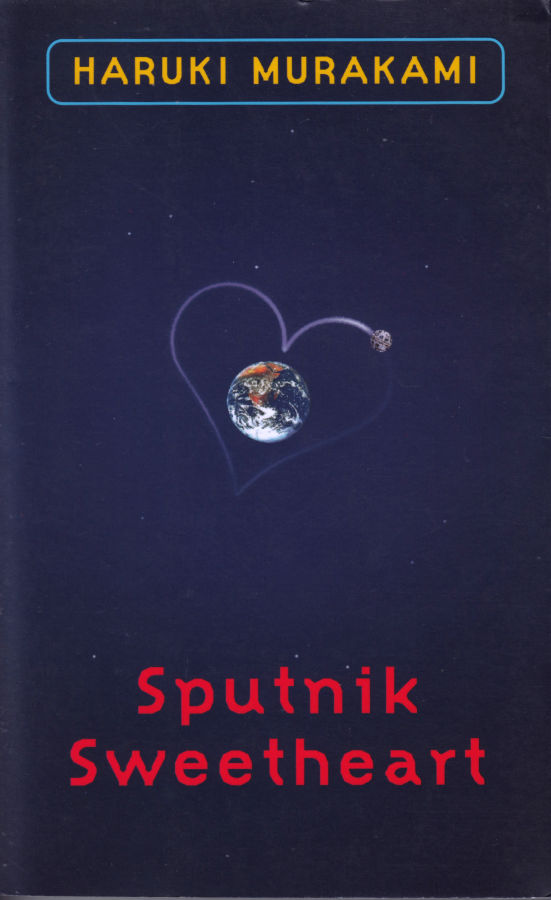
Sputnik Sweetheart by Haruki Murakami

cover art by Jamie Keenan

Sputnik Sweetheart was first published in Japan in 1999, and translated into English by Philip Gabriel in 2001. It was Murakami’s first novel since completing his (at the time) longest work, The Wind-Up Bird Chronicle (whose last volume came out in Japan in 1995), and though he had brought out a non-fiction book, Underground, in 1997, he spoke about this new novel being an explicit attempt to restart his writing.

It’s told by a typical Murakami narrator (mostly unnamed, but when he has to be, he’s called K), a 24-year-old teacher noodling his way through a life he feels mostly disconnected from. He’s in love with Sumire, a quirky 22-year-old woman who might well be dismissed as a manic pixie girlfriend (she dresses in mismatched male clothes, and phones at all sorts of odd hours with random questions like, “What’s the difference between a sign and a symbol?”), if only she were, actually, his girlfriend. Sumire has absolutely no desire for K. In fact, she says, she feels no sexual desire at all. Instead, she’s focused on wanting to be a writer, and is busy churning out hundreds of pages of unfinished stories and novels.

K tells her she needs “time and experience” to become the writer she wants to be. And, as if on cue, Sumire suddenly falls in love, with a 39-year-old businesswoman, Miu. Miu offers her a job as a personal assistant, and after a while takes her on a business trip to Europe. There, they’re given free use of a villa on a remote Greek island, and the two use it for a holiday. Sumire finally declares her love for Miu, but Miu says she can feel no desire for anyone. She hasn’t been able to for the past fourteen years, since a strange incident occurred on a fairground Ferris wheel in a Swiss town where she’d been staying. She has never understood the incident, but since it occurred, has only felt “half the person I used to be”. Formerly a promising pianist, she suddenly found her playing to be soulless, and gave up. She has never since felt any sexual desire for anyone. On the night it occurred, her hair turned perfectly white.

The night after this rejection, Sumire disappears. It’s a small island, with few dangers, and nobody knows where she might be. Miu phones K and asks him to come to the island, but all he can do, when he arrives, is suggest she talk to the Japanese embassy and contact Sumire’s parents. Left on his own, he reads Sumire’s diary. Here, Sumire relates the story of what happened to Miu on that Ferris wheel fourteen years ago, after which Miu felt part of herself had been removed to another world. Sumire wonders if that Miu—the Miu in the other world—might be able to return her love. So is that where she’s gone, to another world?
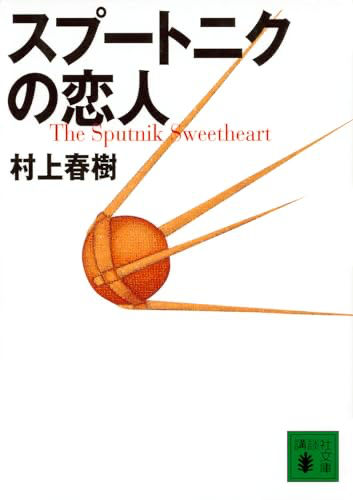
Japanese edition

Sputnik Sweetheart is a short novel (particularly considering the doorstops Murakami has been producing lately: 1Q84, Killing Commendatore, and The City and Its Uncertain Walls), and it boils down one aspect of Murakami’s writing to its simplest form. After setting up the initial situation—in which K loves Sumire but she doesn’t desire him, and Sumire loves Miu but she doesn’t desire her—for the first half-plus of the novel nothing much happens. Things simmer, waiting for the story to emerge. People promise to reveal some important story, but first have to have a meal, then say they should go somewhere they can talk properly, and when they get there they have a drink and talk about other things before, finally, the story begins—but always with the storyteller first rambling for a while about how they don’t know how to tell this story. Then, suddenly—at last—a story is told. The tale of what happened to Miu up that Ferris wheel is like the intrusion of a scene from a David Lynch film or Robert Aickman story, a sudden moment of such strangeness it defies rational explanation, but nevertheless is loaded with enough meaning to bring all the laid-back noodling of the preceding pages into some sort of focus. (Though, having said it defies rational explanation, Miu’s experience could be read as a particularly intense moment of dissociation during a traumatic assault.)
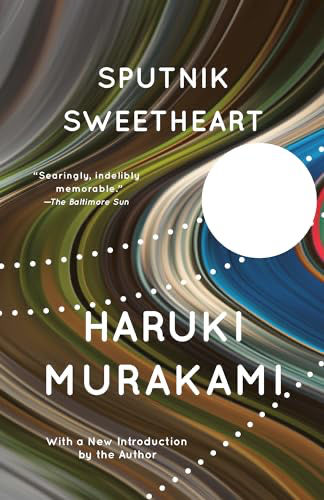
This, as with so many Murakami novels, is a tale of loneliness and loss, whose three main characters have all lost an aspect of themselves that leaves them unable to fully connect with others. Sumire lost her mother when she was three, and after that her beloved cat disappeared in a strange incident where it seemed to climb a tree and never come down. Miu, a Korean born and raised in Japan, always felt as though she never belonged, and then loses that vital part of herself on the Ferris wheel that night. The narrator, meanwhile, is a typically distant Murakamian man, who asks of himself such questions as “Who am I? What am I searching for? Where am I going?” He’s good at his job, but he’s not exactly passionate about it; he has affairs, but never gets too emotionally involved.

The book’s title is Sumire’s nickname for Miu, who mistakenly called her a “Sputnik” when she meant “beatnik”, but the Sputnik reappears throughout the book as a symbol of loneliness. Although the word itself means “travelling companion”, the image of “lonely lumps of metal on their own separate orbits” becomes particularly poignant when you think of Sputnik 2, with its poor dog Laika on board—the first living thing to go into space, only to die there, alone. Satellites, then:

“From far off they look like beautiful shooting stars, but in reality they’re nothing more than prisons, where each of us is locked up alone, going nowhere… Until we burned up and became nothing.”

By the end of the novel K is wondering “Was the Earth put here just to nourish human loneliness?”, making it seem as though, lonely as Sputnik is, it’s looking down on a world of loneliness anyway.

It’s not, though, a sad novel. There’s Murakami’s gentle humour (“If they invent a car that runs on stupid jokes, you could go forever”), and equally gentle mysticism (“Any explanation or logic that explains everything so easily has a hidden trap in it”). After Sumire’s disappearance, its final chapters are mostly lyrical meditations; the answers the novel provides are consolations, not resolutions.

It can, though, also be read as a book about becoming a writer. Sumire wants to be a writer, and at first writes lots, but lacks the “time and experience” to really be the writer she wants to be. After she falls in unrequited love with Miu, she is evidently getting—however painfully—just the sort of experience she needs. K had advised her, of her writing, “Give it time, it’ll take you under its wing, and you may very well catch a glimpse of a new world.” And it seems Sumire takes this literally, journeying to a whole new world in search of Miu’s lost other half, the other half that might love her back, like a sort of erotic shaman. And one way of reading the ending is that Sumire, as the narrator’s own muse, makes contact once more, having been to that other world and experienced loss, love, “time and experience”, and is now ready to write again, if only through K. (In the novel, K tells Sumire’s story, and Sumire tells Miu’s story, in a sort of echo of their unrequited loves.)

Jay Rubin (Murakami’s other translator) in Haruki Murakami and the Music of Words is dismissive of Sputnik Sweetheart, but his reasons all centre on its explicit use of the idea of another world, which he finds too forced. From his reasoning, it sounds as though he has no real feel for the fantastic or supernatural. (Perhaps the part of him that does is lost in another world…) I think the novel’s weird element works perfectly both as a poignant metaphor for the book’s themes of loss, loneliness, and creativity, and as a tale which walks the same line between dream and reality as you find in the likes of David Lynch and Robert Aickman.

^TOP

Hit Parade of Tears by Izumi Suzuki

A second collection of Suzuki’s stories, following on from last year’s Terminal Boredom, this book contains her breakthrough SF story “Trial Witch” — a title which wrongfooted me, because those words inevitably conjure the phrase “witch trials”, whereas in this case it means “apprentice witch on her trial period”. It’s the comical story of a woman who, out of the blue, is told she’s been selected by the League of Witches to become one of their number. She’s granted magical powers for a limited period, but finds her main ability is to transform her husband into a variety of new forms, which she either can’t, or doesn’t want to (he’s unfaithful), undo by the time the trial ends. It’s fun to imagine this story as the image of Suzuki herself, self-trialling herself as a writer in the fantastical vein. Only, unlike with the story’s protagonist, Suzuki turned out to have, with this story, won herself a place as a writer of SF in Japan (though not, it turns out, to have been allowed into the all-male SF Writers Club of Japan).

The main feeling I came away from in my review of Terminal Boredom was of emotional disconnection in human relationships, edging its way into emotional disconnection from oneself. With some of the stories of Hit Parade of Tears, that aspect is ramped up, with sometimes quite extreme self-alienation being a predominant theme in the longer, more serious tales.

That feeling of distanced relationships is still there, as in this, from the opening story, “My Guy”, about a young woman who finds herself picking up a man who says he’s an alien from another world:

“I guess I’d never really been in love, or even learned what was involved in ‘liking’ someone. This could be why I always seemed to wind up in relationships defined by mutual distaste and an inability to walk away.”

The alien man tells her things are the same on his world:

“Back home, everyone starts making love, so to speak, once they reach adulthood, except only with the partner that the government assigns them. Then they spend the rest of their lives as a happy couple who never fight. But that isn’t what you’d call ‘love’ now, is it…”

But elsewhere in the book — in what I feel is probably a later tale — Suzuki seems to have hit on something of a solution, only a messily human one, when in the story “I’ll Never Forget” she presents us with an ever-squabbling-and-making-it-up couple, who keep their relationship fuelled by the failures of previous ones:

“They were a strange pair, these two. They each prodded at some past infidelity, real or not, and that’s what formed the basis of their relationship.”

Which leads to the realisation:

“…love isn’t like a house you can just kick back and live in once it’s completed. No, it gets more worn and tattered day by day. So unless you keep on making it up, day by day, it disappears in all but name.”

But it’s the alienation from oneself that dominates Hit Parade of Tears. In what may be the longest tale, “Hey, It’s a Love Psychedelic”, a woman, initially called Reico, then Reyko, then Reiko, finds herself transplanted to what seem to be alternative versions of her own life. In each, she’s aware that things are wrong, usually through her knowledge of popular culture — an album that should have been out, or a brand of cigarettes that shouldn’t be available yet. The time-stream of her life is being manipulated by someone, taking her further away from the life she knew: whereas in the first section of this tale, she’s actively involved in the 1960s/70s rock music scene, by the last section she’s merely reading about it in a trashy novel called Groupie.

Some Japanese covers to Suzuki’s books

“The Covenant” starts with a somewhat useless-seeming husband figure who claims to be telepathic and in contact with aliens from another world, who he somehow helps with his mental powers. Then we meet a girl whose self-alienation starts out as an emotional self-disconnection similar to other Suzuki characters:

“Akiko had been alone ever since she was a child. She’d never had friends. She’d been a taciturn, expressionless, polite child. Her good grades had made her something of a teacher’s pet, but she never cared about any of that. After many long years of resenting the fact that no one loved her, she had conceived a vague hatred for this world.”

But she comes to realise these feelings are because she is (or so she believes), an alien from another world, here on Earth to fulfil the covenant of the story’s title. She forms a friendship with another similarly outsiderish girl, and things get a bit Charles Manson-ish.

The starkest image of self-alienation, though, is in “Memory of Water”. Here, the main character is a woman whose agoraphobia has led to her being mostly cut off from the world, and barely leaving her flat. But there are inexplicable (and, to her, alarming) intrusions into even that safe space, such as phone calls from a man who seems to know her, and items of clothing she’d never wear suddenly appearing in her wardrobe. Unknown to herself, she has a second self, one who is not anxious, depressed and sick, but whose idea of a free, adventurous life is one she’s so afraid of, she has cut that whole self off to the point that it has managed to break away and live an independent life. But instead of embracing this new self, the anxious woman only retreats further.

This feeling of being linked to another person, one whose mental and physical ill-health is dragging you down, also pops up in a tale I’ve already mentioned, “I’ll Never Forget”, which is actually a sequel to the story “Forgotten” from Terminal Boredom. “Forgotten” presented us with an alien but humanlike race, the Meelians, who never forget, which is why they don’t have war on their planet. In “I’ll Never Forget”, though, we learn there’s a downside to this never forgetting, as Meelians’ emotional experiences never fade; as a result, when “their heart has exceeded its capacity”, they tend to take their own life. (Human beings, on the other hand, merely descend into “a sort of hellish torment”. Thanks.) The main character, a Meelian woman who’s on Earth to do some modelling work, finds herself unconsciously targeted by the telepathic emanations of the human woman from “Forgotten”, who loved a Meelian man, Sol, who’s now dead. Alongside this feeling of being burdened by a stream of negativity that mixes physical ill-health, depression, and a feeling of life-failure, there’s the helplessness of not being able to do anything about it. In this sense, both “I’ll Never Forget” and “Memory of Water” are quite despairing tales.

Cover by Araki

As with Terminal Boredom, there’s no indication of when the Japanese originals from Hit Parade of Tears were first published, but I’m willing to bet that “The Memory of Water” and “I’ll Never Forget” date from the end of Suzuki’s career. That feeling of being burdened by longstanding physical ill-health, as well as mental ill-health and a feeling of the failure of human relationships chimes too much with Suzuki’s biography to ignore. (And I realised I should have taken my own advice from my review of Terminal Boredom: “I’d like to read some more stories by Suzuki, though perhaps I wouldn’t read them back-to-back, as that malaise of disaffection can be hard to read too much of.”)

There are some tales in Hit Parade of Tears that escape this negativity, though. Perhaps my favourite is one of the most explicitly genre-science-fictional, “Softly, As In A Morning Sunrise”, about the human crew of a spaceship exploring other planets, not for the purposes of scientific advancement — there are just too many planets out there for every one of them to be treated with such care and attention — but as part of “a get-rich-quick scheme to collect unusual animals for Earth’s leisure class”. This mismatched, flawed, and very un-military-SF crew, collect a bunch of animals from various planets, half of which die, some of which injure or poison the crew. On this planet, they find what seems to be a human baby, and their disagreements about what to do with it lead to a near mutiny. But the captain, who is equally fed-up with their mission, decides to take a new, and very un-Captain Kirk-ish solution: she says maybe they should give up and just live on this planet as they are.

It would be interesting to know when this story was written. The idea of a crew setting down on an alien planet and collecting specimens has been done in SF before, but the crew’s mismatchedness, and the detail that, back on Earth, there’s a “nerve centre linking the computers used by the various government ministries” called “MOTHER”, recalls the fact that the Nostromo’s computer is also called “Mother”, which makes me wonder if this isn’t a jokey take on Alien.

I think I like Suzuki most when she’s engaging explicitly with the sort of big ideas you find in genre SF — she inevitably has a fresh and meaningful take on them, alongside a carefree sense of humour and a wide acceptance of human foibles. But elsewhere there’s that overpowering emotional malaise and feelings of despair that just can’t be channelled into the sort of punky kicking back at society that would give this collection the life it needs. I really didn’t enjoy that aspect this time around.

^TOP

Convenience Store Woman by Sayaka Murata

Had Convenience Store Woman (2016 in Japan, English translation 2018) been written eighty years ago, would it have been hailed as a classic of Existentialist literature? It’s narrated by Keiko, a single thirty-six year-old who has been working as a part-time employee at the same convenience store since she was eighteen. Keiko is neuroatypical (a term unavailable to those Existentialist heroes such as Camus’ Mersault) to the extent that most people’s ways don’t make sense to her, so to avoid being singled out and treated as a “foreign object” she has learned to simply adopt others’ behaviours, including their ways of speaking and mode of dress, so as to pass unnoticed, as much as she can.

To this end, working at a convenience store — the highly-regimented Japanese version of one, anyway — is the perfect solution, as the company that runs it supplies employees with a manual that covers everything from personal grooming to what phrases to use when talking to customers. Keiko, then, is in her element there, as it’s a place where it’s completely unambiguous how she should act in every situation. It’s outside the store things are occasionally tricky, but she has managed to fob off her few social contacts when they ask why she’s still single and working in a part-time job — why she’s a “freeter”, to use a term I hadn’t encountered before — with the excuse that she has some vague health problem that makes her too “weak” for a regular job. But then an acquaintance’s husband, meeting Keiko for the first time and hearing this excuse, points out the obvious: if she’s unwell and “weak”, a convenience store is the worst place to work, as she’s on her feet all day.

Keiko realises she’s going to need a new excuse. The solution comes in the form of a character who, in some ways, points to how Keiko’s life could have been had she not chosen to so assiduously fit in. Shiraha starts work at the convenience store but is utterly unsuited to it, and has no intention of adapting to any of its ways. A tall, thin, unkempt man, he makes no bones about finding working in such a place beneath him — while evidently being unable to find anything better — and resents it every time the manager tells him to do something. Shiraha mutters constantly, and quite audibly, how crummy the shop and its workers are, and how wrong it is he should be expected to work there. He constantly harps on about the archetypal “Stone Age”, when men went out to hunt and women stayed at home — sometimes using it as proof that, as a man, he ought to be above working in a convenience store, at other times using it as an explanation for why he is such an outsider, as his life doesn’t fit into the dictates of the mythical Stone Age “village”, and so he’s rejected by society. It’s no surprise, then, when he’s fired from the store — not for slacking, amazingly enough, but for harassing female customers and employees, as he admits to Keiko he only got the job to find a wife, one who could support him in his vague aim of starting an online business.

But where everyone else sees in Shiraha an utter failure, Keiko sees the solution to her problem. If she had a husband, her friends would no longer be asking why she’s working at a part-time job, as it’s a socially acceptable thing for housewives to do. And Shiraha, pretty much homeless and hopeless, is unlikely to get a better offer. He does accept — though in such a grudging way as to make it clear he’s doing her a favour. (Keiko, on the other hand, uses the language of keeping a pet with regard to Shiraha — she talks about his “feed”, when giving him a meal, for instance — her way of adapting to a situation she’s never been in before.) But when she lets drop at the store that she’s now living with Shiraha, things start to change in a way she doesn’t like: her fellow workers suddenly become interested in her as a human being instead of merely a fellow employee, and far from solving her problem, it looks like her carefully balanced mode of life is set to topple completely.

Camus’s Mersault from The Outsider — much more a Shiraha than a Keiko — would never work in a convenience store, and Keiko feels none of the sort of Sartrean “nausea” for normal life that your average Existentialist hero does. She finds it incomprehensible, yes, but sees that incomprehensibility as a practical problem, not a philosophical one. She also seems to have no other priorities. Fitting in has become her entire life, and even her hours outside work are all about preparing for the next day — eating enough, sleeping enough, keeping herself acceptably groomed. When Shiraha appeared in the narrative, I thought he was, basically, her Jungian shadow, openly embodying everything about herself she must be repressing. He’s the embodiment of a stubborn resentment at being expected to fit in, to the extent that he doesn’t even wash frequently. It makes such perfect psychological sense when they move in together, for I can’t help feeling that, deep down in Keiko, there must be some sort of deeply repressed Shiraha of her own.

But Convenience Store Woman doesn’t have that tragic Existentialist-novel ending. Keiko doesn’t share the fate of Camus’ Mersault (executed for displaying such emotional indifference to the death of his mother that everyone assumes he must also be guilty of the murder he’s accused of) but instead might fit into Camus’s interpretation of Sisyphus, whom Camus says we must assume to be happy eternally pushing a rock up a steep incline only to have it roll back down again. In a complex and challenging world, Keiko has found a way of fitting in, despite her inability to understand why her fellow human beings act the way they do. But is her situation one of Existentialist horror — never being truly free — or one of practical choice — even, ultimately, a sort of fulfilment? Her willingness to fit in evolves into a super-sensitive awareness of how her little convenience store world works, until she can respond to its needs instinctively.

Perhaps she can even be read as a sort of Everywoman. Used to consciously adopting others’ behaviours, she’s aware how much everyone else does this, too, though they do it unconsciously. They take on the manner of their social group, they copy one another’s fashion choices, they submit to the way things are without question. At least she’s conscious of these things, even if it’s a consciousness that leaves her puzzled.

In doing the same things — perhaps to greater lengths, but ultimately to the same ends — is Keiko not exercising her Existential freedom? And, doing it consciously, doesn’t that make her that much more an Existential hero?

I don’t know what Sartre or Camus would have made of it, but unlike Camus’ The Outsider, this is no great work of despair about the human condition. Keiko comes to a sort of fulfilment, in recognising that she has, indeed, won for herself a genuine relationship in a life otherwise marked by estrangement and incomprehension. Not her relationship with Shiraha, but with that other living being she understands so much better, and which serves her as much as she serves it: the convenience store.

^TOP
